What Springboard’s self-paced, mentor-led programs in software engineering, data and UX design cost, what the money-back guarantee really requires, and who they fit.
By Michael Stromberg, Hack Reactor graduate (2016) · Last verified November 17, 2026
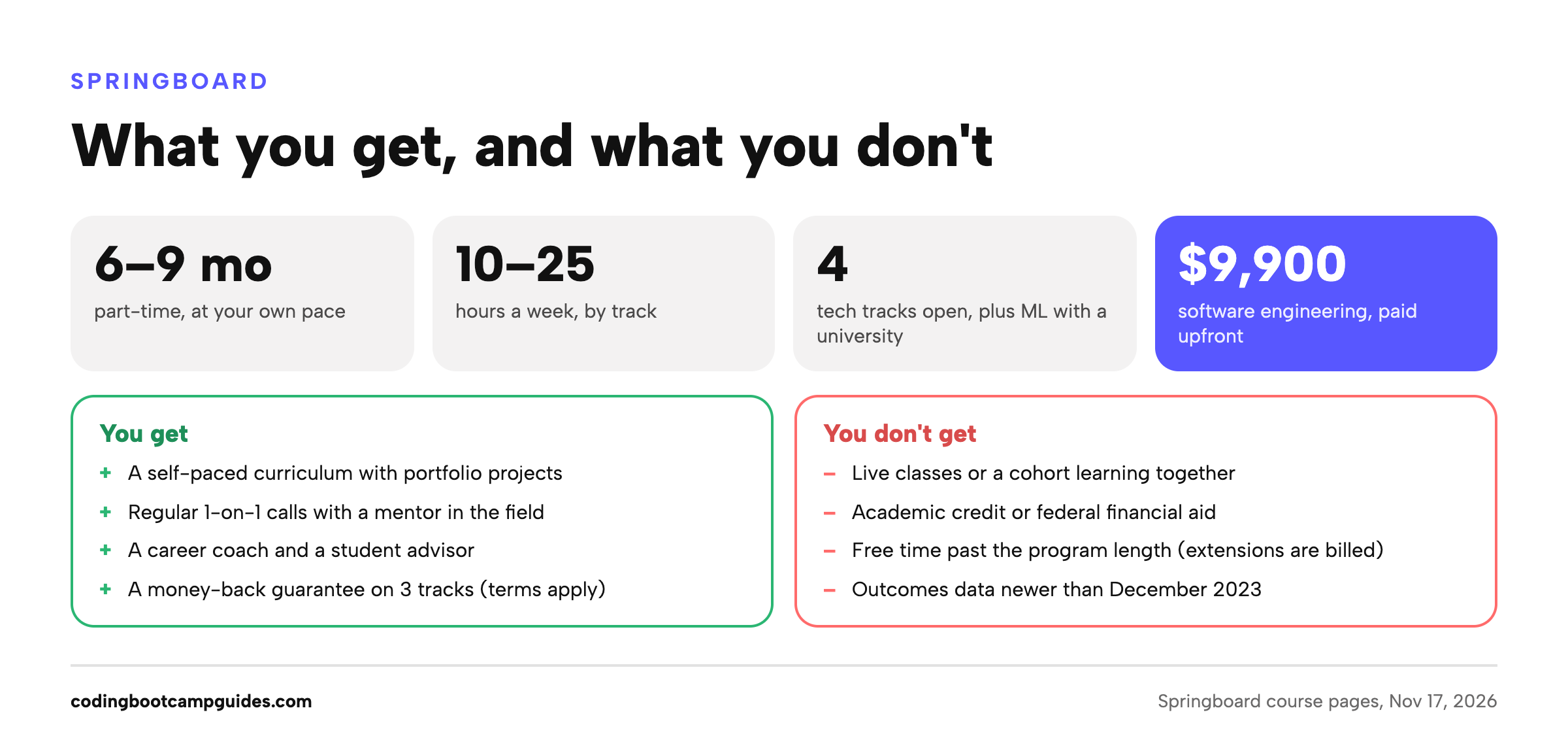
Springboard is one of the longest-running online bootcamps. It doesn’t teach live classes: you work through a self-paced online curriculum, meet regularly with a mentor who works in the field, and get a career coach for the job search. Its software engineering, data analytics, and data science tracks come with a money-back guarantee. We read every course page, the full guarantee terms, Springboard’s state-filed course catalog, and its reviews to work out what you actually get for $7,190–$9,900.
The short answer: Springboard is a reasonable choice if you need to keep your job, can study on your own 15–20 hours a week, and want a mentor and a coach keeping you accountable. Pay upfront if you can: it saves $1,500–$3,960. Don’t buy it for the guarantee alone. The guarantee is real, but it asks for a full-time job search (10 applications, 10 networking messages, and weekly reports every week) for up to a year, and it counts any paid role in your field of 30 hours a week as a job, with no minimum salary.
Springboard at a glance
| Springboard | |
|---|---|
| Tracks open now | Software Engineering, Data Analytics, Data Science, UI/UX Design, and a Machine Learning & AI bootcamp run with the University of Arizona |
| Format | 100% online and self-paced, with regular 1-on-1 mentor video calls, a career coach, a student advisor, and a Slack community. No live classes |
| Length | 6 months (data analytics, data science) or 9 months (software engineering, UI/UX), part-time |
| Weekly time | 10–25 hours, depending on the track |
| Price | $7,190–$9,900 if you pay upfront; $8,690–$13,900 list |
| Prior experience | Software engineering needs basic JavaScript; data science needs Python and statistics. Beginners can start with a free “Foundations to Core” add-on |
| Money-back guarantee | Software engineering, data analytics, and data science only. Not UI/UX |
| Start dates | Rolling cohorts; you pick a start date when you enroll |
| Credential | Certificate of completion (not academic credit) |
What’s changed at Springboard
Many Springboard reviews online describe an older lineup. As of November 2026:
- The cybersecurity bootcamp is gone. Its page now says the Cybersecurity Career Track “has been discontinued” and isn’t accepting applications.
- Machine learning moved to a university partner. The Machine Learning & AI Bootcamp is now “developed in partnership with” the University of Arizona Continuing and Professional Education, and Springboard’s page doesn’t show its price. (The same page also sends you to a University of Massachusetts Global course page for the syllabus, so ask admissions which school you’d actually enroll with.)
- Healthcare is new. Springboard now lists medical assistant, pharmacy technician, and sterile processing technician programs alongside its tech tracks.
- AI units were added to every tech track: prompt engineering for coders, and AI units for data and design students.
- Prices dropped. UI/UX was $9,900 in Springboard’s November 2024 catalog; it’s $8,690 list ($7,190 upfront) now.
- The outcomes data hasn’t been updated since December 2023. More on that below.
How Springboard works
Springboard is self-paced, not a live bootcamp. There are no daily lectures or classmates working through the same lesson at the same time. Instead, you get:
- A curriculum of articles, videos, exercises, and portfolio projects. The software engineering videos come from Colt Steele, a well-known online coding instructor.
- A mentor who works in the field and meets you on “regular” video calls. You set the agenda. Springboard’s pages don’t say how often or how long the calls are, so ask.
- On-demand help from other mentors, plus a Slack community.
- A student advisor who helps you stay on schedule.
- A career coach. The home page says coaching lasts “up to six months” after you finish. (The November 2024 catalog said 12 months.)
That structure suits people who are self-directed but want someone checking their work. If you need a teacher in front of you every day, a live bootcamp such as Hack Reactor or App Academy is a better fit.
Programs and prices
| Track | Length (part-time) | Hours a week | Upfront price | List price | Guarantee |
|---|---|---|---|---|---|
| Software Engineering | 9 months | 16–20 | $9,900 | $13,860 | Yes |
| Data Science | 6 months | 20–25 | $9,900 | $13,900 | Yes |
| Data Analytics | 6 months | 10–15 | $8,900 | $11,300 | Yes |
| UI/UX Design | 9 months (plus a 4-week externship) | 15–25 | $7,190 | $8,690 | No |
| Machine Learning & AI (with Univ. of Arizona) | 9 months | Not stated | Not shown on Springboard’s site | — | Not stated |
Prices are from each course page on November 17, 2026. The list price includes a $250 application, processing, and onboarding fee that Springboard’s catalog says is non-refundable.
What it really costs
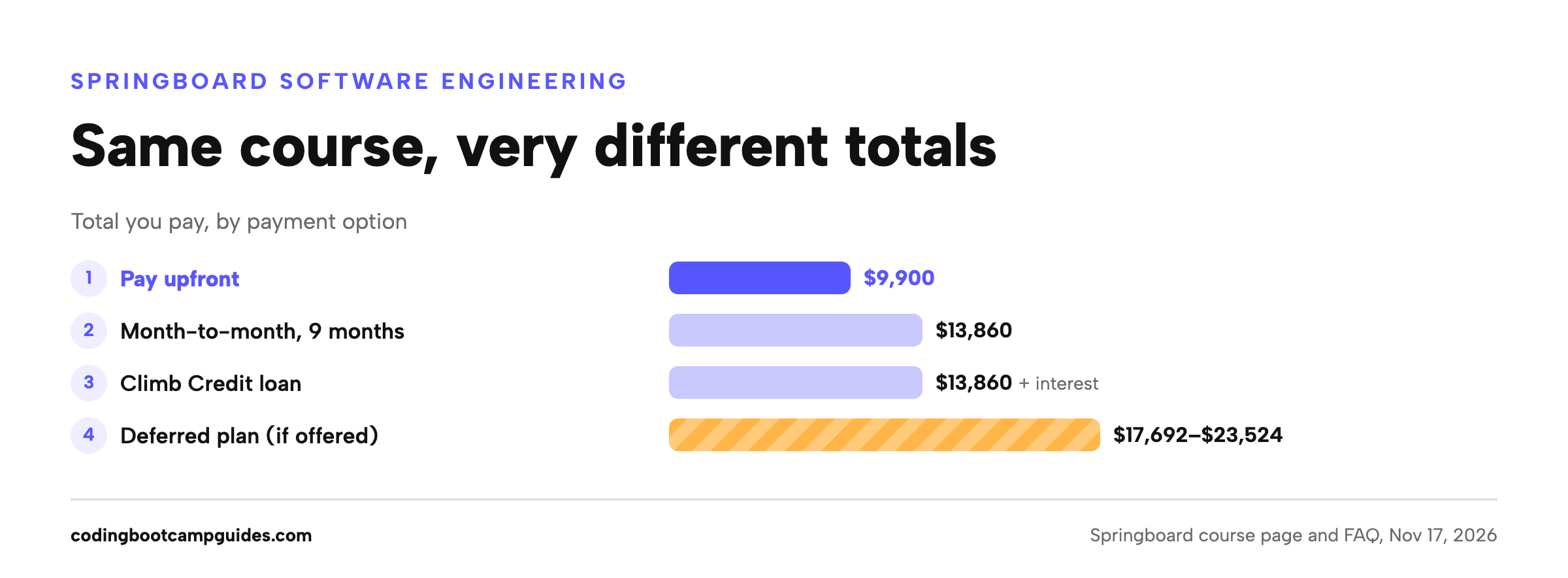
Every track offers the same three ways to pay. Here they are for software engineering:
| Option | Software engineering total | How it works |
|---|---|---|
| Pay upfront | $9,900 | Pay in full at enrollment. A 29% discount off the list price. |
| Month-to-month | $1,540 a month; $13,860 if you take 9 months | You pay until you finish. Finishing early costs less, but at the expected pace it’s $3,960 more than paying upfront. |
| Loan through Climb Credit | $13,860 plus interest | $500–$700 deposit, $20–$476 a month during the course, then $379–$767 a month for 30–33 months. U.S. residents only; terms depend on your credit. |
Two more costs to plan for:
- Running over costs extra. Springboard’s terms of service say that if you stay enrolled past your program length, you must buy a “Paid Extension,” billed monthly. The November 2024 catalog listed $600 a month for software engineering, $700 for data analytics, $800 for data science, and $750 for UI/UX. Pausing also extends your end date, and pauses don’t stop your scheduled payments.
- There’s a deferred plan, but get it in writing. One FAQ on the beginner software engineering page describes deferred tuition: a $700 deposit, nothing more until you start a job, then $472–$634 a month for 36 months. That works out to $17,692–$23,524 in total, roughly two to two and a half times the upfront price. It isn’t listed in the tuition section, so ask whether it’s still offered.
Springboard doesn’t accept federal financial aid. For other ways to fund a bootcamp, see our guide to paying for a coding bootcamp, and run your numbers through the bootcamp break-even calculator.
Admissions and prerequisites
Admissions is an application (about 10–15 minutes), a call with admissions, and a “technical skills survey” that most people finish in under 45 minutes. If you pass, you get a registration link to pick a start date and payment plan. Each track expects different starting skills:
- Software engineering: basic JavaScript (functions, loops, conditionals, variables) and problem-solving. HTML and CSS are recommended.
- Data science: Python and basic statistics (mean, median, standard deviation, distributions).
- Data analytics: at least two years of professional experience using office, design, or programming tools.
- UI/UX design: an evaluation of visual, analytical, and empathy skills. All backgrounds are welcome.
If you’re a beginner, Springboard offers “Foundations to Core” versions of the software engineering, data analytics, and data science tracks at no extra cost. For software engineering, that’s 15 weeks at 40 hours a week or 40 weeks part-time at 11–17 hours a week, and the guarantee deadline moves from 9 to 10 months.
What you’ll learn in software engineering
The software engineering track teaches full-stack JavaScript with the MERN stack (MongoDB, Express, React, and Node.js):
- How the web works, the command line, and setting up Node.js, MongoDB, and PostgreSQL
- JavaScript, HTTP, REST and GraphQL APIs, and the model-view-controller pattern
- React on the front end; Node.js and Express on the back end
- An “AI for Engineers” unit on prompt engineering and using AI tools to code
- Six mini-projects and five portfolio projects, ending with a full MERN capstone
- Career units on job search strategy, résumés, LinkedIn, interviews, and salary negotiation
That’s a solid, standard full-stack curriculum, and React plus Node.js is still a sensible first stack. Two things to know: the published units don’t cover cloud deployment or computer science fundamentals like data structures and algorithms in depth, and the AI unit is about prompting, not building AI features into apps. Ask for the full syllabus before you enroll.
The data analytics track covers Excel, SQL, Tableau, Power BI, and Python, with 33 mini-projects and two capstones. Data science covers Python, SQL, and machine learning. If you’re weighing data analytics, compare it with the Google Data Analytics Certificate, which teaches many of the same tools for a fraction of the price but with no mentor.
The money-back guarantee: what it actually requires
Springboard advertises a “money-back guarantee” on software engineering, data analytics, and data science. If you meet every requirement and don’t get a qualifying job, it refunds 100% of the tuition you paid. We read the full terms for each track (version dated August 7, 2025, for cohorts starting September 2025 or later). Here’s what they say.
Who is eligible
- You must be 18 or older, pass a third-party English assessment, live in the U.S. or Canada, and be authorized to work there for at least 2 years after graduating.
- Data analytics and data science require a bachelor’s degree (or finishing one partway through the course). Data analytics also requires 2 years of professional experience. The software engineering terms don’t require a degree.
- You must be able to pass background checks for the jobs you apply to.
What you have to do
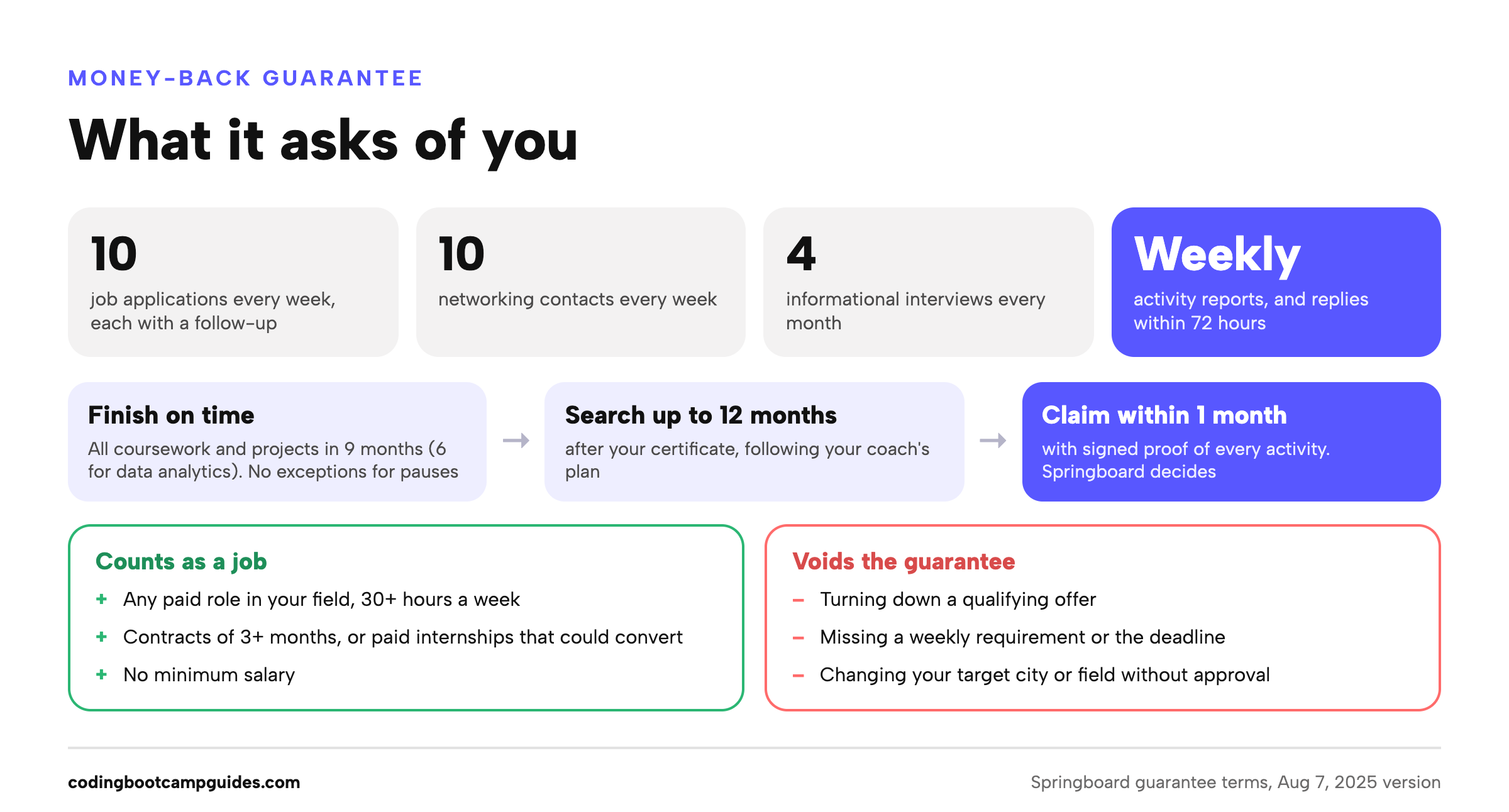
- Finish on time: 100% of the core curriculum and projects within 9 months of your start date for software engineering and data science (10 with Foundations to Core) or 6 months for data analytics. The terms say “there are no exceptions,” and pauses don’t extend the deadline.
- Every week of the job search: apply to at least 10 qualifying jobs with a follow-up on each, reach out to at least 10 people, and submit a weekly activity report.
- Every month: 4 informational interviews and 2 skill-development activities.
- Always: pass mock interviews, attend coaching calls, follow your coach’s job-search advice, and answer Springboard within 72 hours. Coaches can raise the minimums.
What counts as a job, and how long it lasts
- A “qualifying position” is any paid role in your field of at least 30 hours a week, onsite or remote, including a contract of 3 months or more or a paid internship that could turn into a full-time job. There’s no minimum salary.
- The job search period runs from enrollment until 12 months after you receive your certificate. Springboard can extend it by 2 months for holiday slowdowns, and it’s extended if you’re mid-interview when it ends.
- You lose the guarantee if you turn down a qualifying offer, accept a non-qualifying job, change your target city or industry without approval, or miss any requirement.
- To claim, you send a signed certification with documentation of all your activity within one month after the search period ends. Springboard has “sole discretion” to decide whether you qualify.
Put plainly, it’s a guarantee that you’ll get some paid job in your field if you work the search like a part-time job for up to a year. That’s worth something, but it isn’t a promise of a well-paid developer job. Note that coaching is advertised for six months after you finish, while the job search period runs for twelve. Read the full terms, linked from each course page and Springboard’s guarantee page, before you count on it.
Outcomes: what Springboard’s numbers mean
Springboard publishes these figures, all dated December 2023:
| Track | Reported 12-month rate | Average salary increase | Students |
|---|---|---|---|
| All Career Tracks | 85.6% | $23,333 | 18,394 enrolled since 2016 |
| Software Engineering | 88.4% | $25,764 | 2,957 enrolled since 2020 |
| Data Analytics | 89.4% | $17,418 | 3,300+ enrolled since 2019 |
| Data Science | 89.2% | $25,434 | Not stated |
| UI/UX Design | Not stated | $24,523 (average starting salary $84,316) | Not stated |
Read the fine print before you rely on these. Springboard defines the rate as the share “of job-qualified individuals who reported an offer” who “received it within 12 months of graduation.” As worded, that counts only graduates who met Springboard’s job-search criteria and reported an offer, so it says little about how many students who enrolled got a job. The salary increase includes only people who reported both salaries. The data is almost three years old and predates the current curriculum and the tougher 2024–2026 entry-level market. The full reports are behind an email form; when you talk to admissions, ask how many students who started a cohort finished, and how many of those got a job.
Springboard’s California catalog also says its Career Tracks are not among its state-approved programs, so California’s student refund rights and its Student Tuition Recovery Fund apply only to its short intro and prep courses.
Refunds and withdrawals
Springboard’s terms of service point to the refund policy in its course catalog. The most recent catalog we found covers November 2024 to October 2025, so ask for the current enrollment agreement. That catalog says:
- Full refund if you cancel before you receive the first lesson and materials, which Springboard sends within seven days of signing.
- After that, if you withdraw within 30 days of getting access to the rest of the material, you get back what you prepaid minus $2,000 and the $250 non-refundable fee.
- The terms of service add that Springboard “may offer” a pro-rata refund for later withdrawals, based on time in the course.
- If a loan paid your tuition, the refund goes to the lender.
In practice, deciding in the first month costs you $2,250, and quitting later depends on Springboard. If you’re unsure, try a free course first.
What students say
- Course Report: 4.6 out of 5 from 1,768 reviews, though the newest one shown was from August 2025. Course Report enters every reviewer in a $500 gift-card drawing, and some reviews include referral links.
- Trustpilot: 3.6 out of 5 from 361 reviews, with 12% one-star. Only 9 were posted in the last 12 months.
In recent reviews, students mostly praise their mentors, the project-based curriculum, and the flexibility. The complaints repeat: slow or inconsistent mentor feedback, projects sent back for revision many times, extension fees, advisors going quiet, and disputes over whether the guarantee applied. Both sites rely on self-selected reviews, so treat them as signals, not proof.
Pros and cons
Pros
- Keep your job. It’s fully self-paced, with no fixed class times.
- Real people in the loop: a mentor who works in the field, a career coach, and an advisor.
- Mid-range price if you pay upfront: $9,900 for software engineering, versus $16,980 or more for Hack Reactor.
- A free path for beginners through Foundations to Core.
- A money-back guarantee on three tracks, with clearly written terms.
- Solid projects: a MERN capstone for software engineering and two capstones for data analytics.
Cons
- No live instruction. Motivation is on you.
- Expensive if you don’t pay upfront: month-to-month costs $3,960 more for software engineering, and deferred tuition could nearly double the price.
- Extension fees of $600–$800 a month if you fall behind.
- The guarantee is demanding and counts any paid role in your field, even a low-paying contract.
- Outcomes data is from December 2023, and the way it’s defined flatters the results.
- Withdrawing after the first lesson costs at least $2,250.
- A shrinking tech lineup: cybersecurity is gone and ML now runs through a university partner.
From Michael, Hack Reactor ’16: Springboard is close to the opposite of the bootcamp I did. Hack Reactor was live and full-time, with instructors and classmates around every day, and that pressure did a lot of the work. Springboard swaps that for a mentor, a coach, and a lot of independence. That suits disciplined people who can’t quit their jobs. If you’ve started and stalled on online courses before, be honest with yourself about whether a call with a mentor will be enough. And I’d treat the guarantee as a backstop, not the reason to buy: it’s mostly a written plan for running a serious job search, which is the part that gets people hired anyway.
Who should choose Springboard?
- Good fit: you’re working full-time, can reliably give it 15–20 hours a week, learn well on your own, can pay upfront, and want a mentor and coach rather than a classroom.
- Look elsewhere: you need live classes and a cohort, you want the cheapest path, you don’t have a degree and want the data analytics or data science guarantee, or you want cybersecurity (it’s discontinued).
- Not sure yet? Do a month of a free curriculum like The Odin Project or freeCodeCamp first. If you can keep going on your own, you’ll get more out of Springboard, and you might not need it.
Springboard alternatives
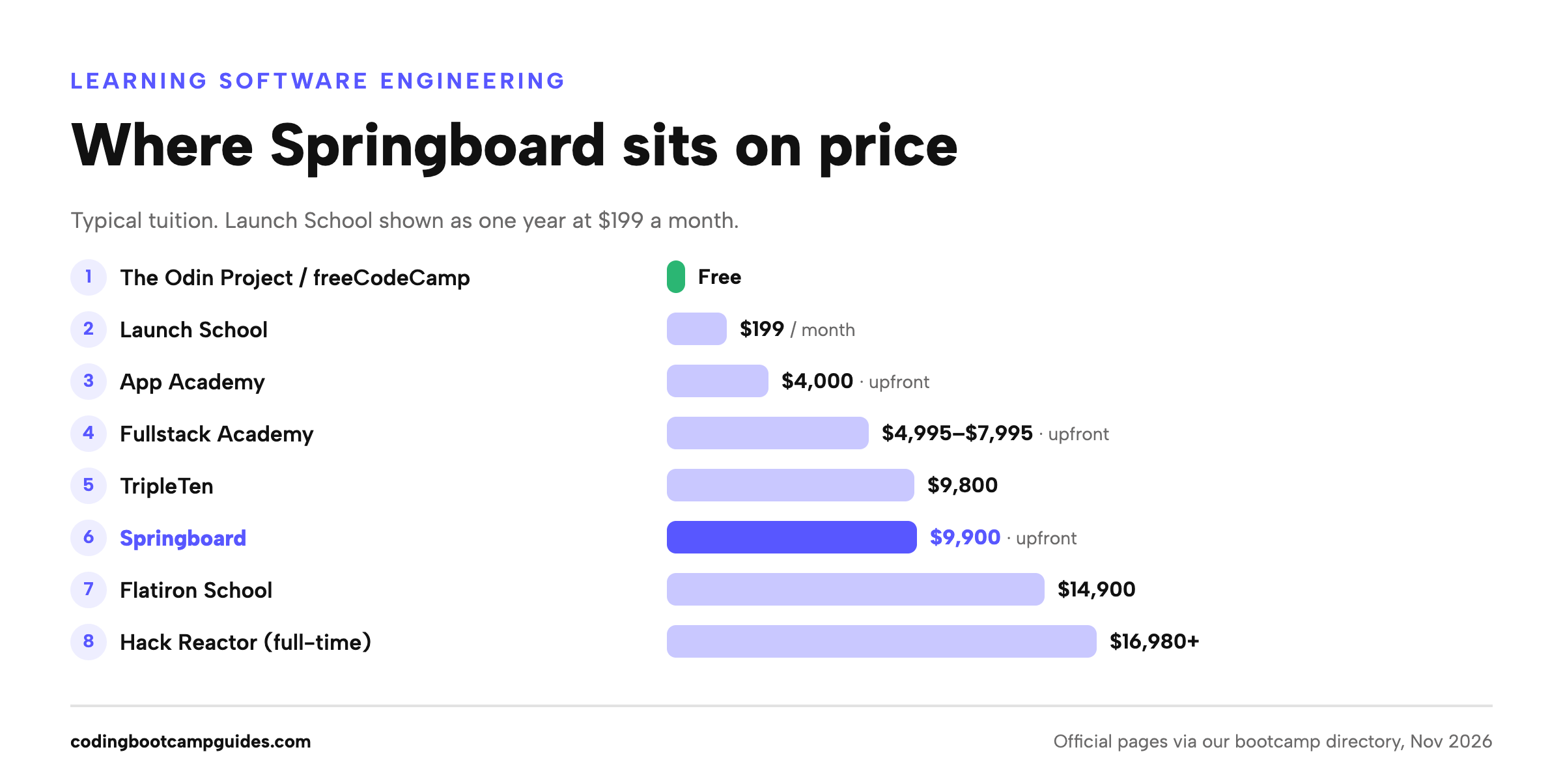
Prices are from our bootcamp directory, checked in November 2026.
| Program | Price | Format | Best for |
|---|---|---|---|
| Springboard Software Engineering | $9,900 upfront | Self-paced with a mentor; 9 months | Working adults who want accountability |
| App Academy | $4,000 upfront ($10,000 list) | Live online, part-time; 4–6 months | Low-cost live instruction, AI and Python focus |
| Fullstack Academy | $4,995 part-time, $7,995 full-time upfront ($11,995 list) | Live online; 13 weeks full-time or 22 part-time | Live classes and a cohort for less |
| TripleTen | $9,800 | Part-time online; about 7 months | A similar price and schedule with a set cohort |
| Flatiron School | $14,900 | Online, full- or part-time | A longer-established bootcamp brand |
| Hack Reactor | $16,980–$19,480 full-time | Live online; 16 weeks full-time or 30 part-time | An intense, live, full-time immersive |
| Launch School | $199 a month | Self-paced, mastery-based; usually a year or more | Depth over speed |
| The Odin Project, freeCodeCamp | Free | Self-paced, no mentor | Testing your interest before paying |
For data analytics, the Google Data Analytics Certificate covers spreadsheets, SQL, Tableau, and Python for far less. For UX, Designlab’s UX Academy ($8,499) is the closest mentor-led alternative.
Questions to ask before you pay
- How often are mentor calls, and how long are they? Can I switch mentors?
- What is the current refund policy after the first lesson? Please send the enrollment agreement.
- What do extensions cost per month now, and how many students need one?
- Is the deferred tuition plan still available, and what is the total cost?
- Of students who started my track in 2024, how many finished, and how many got a job within 12 months?
- Do I meet every eligibility requirement for the money-back guarantee? Please confirm in writing.
- For machine learning: which university do I enroll with, and what does it cost?
The verdict
Springboard is a legitimate, established option for working adults who learn well on their own and want a mentor and a coach keeping them on track. At $9,900 upfront, software engineering is mid-priced, and the curriculum and projects are solid. The weak spots are the cost of paying any other way, the $2,250 cost of changing your mind after the first lesson, outcomes data from 2023, and a guarantee that’s demanding and doesn’t promise a good salary. If you can study on your own and pay upfront, it’s worth a call with admissions. Bring the questions above.
Still comparing? Browse every option in our bootcamp directory, or read our Hack Reactor and App Academy reviews.
Springboard FAQ
Is Springboard worth it?
For working adults who can study 15–20 hours a week on their own and pay upfront, it can be. Software engineering costs $9,900 upfront for 9 months of self-paced work with a mentor and a career coach. If you need live classes, or the lowest price, other options fit better.
How much does Springboard cost?
As of November 17, 2026: software engineering $9,900 upfront ($13,860 list), data science $9,900 ($13,900), data analytics $8,900 ($11,300), and UI/UX design $7,190 ($8,690). Month-to-month plans and Climb Credit loans cost more.
Does Springboard really refund your tuition if you don’t get a job?
On the software engineering, data analytics, and data science tracks, it refunds 100% of the tuition you paid if you meet every requirement and don’t get a qualifying job within 12 months of finishing. The requirements include finishing on time, 10 applications and 10 networking contacts a week, and weekly reports. Any paid role in your field of 30 hours a week counts as a job, regardless of salary.
Is Springboard self-paced?
Yes. There are no live classes. You work through an online curriculum on your own schedule and meet regularly with a mentor by video call. Courses are designed to take 6 or 9 months part-time, and staying enrolled longer costs extra each month.
Does Springboard still offer cybersecurity?
No. Springboard’s cybersecurity page says the Cybersecurity Career Track has been discontinued and is no longer accepting applications.
Is Springboard accredited?
No. Springboard is approved to operate by California’s Bureau for Private Postsecondary Education, but its catalog says the Career Tracks themselves aren’t among its state-approved programs. You get a certificate of completion, not academic credit, and Springboard doesn’t accept federal financial aid.

Michael has a diverse background in software engineering, mechanical engineering, economics, and management. After a successful career in mechanical engineering, Michael decided to become a software engineer and attended the Hack Reactor coding bootcamp. Michael enjoys writing about his experiences and helping others start their journeys in software development.