By Michael Stromberg, Hack Reactor graduate (2016) · Last verified November 11, 2026
The Google Data Analytics Certificate is one of the most popular programs on Coursera: almost 4 million people have enrolled. It costs about $49 a month, needs no experience or degree, and teaches the everyday work of a junior data analyst: spreadsheets, SQL, Tableau dashboards, and, since its latest update, Python. This review covers what’s in it now, what it really costs, how long it takes, and what it takes to turn it into an analyst job.
The short verdict: it’s the best-value way to learn the basics of data analysis and find out whether you like the work. It won’t get you hired on its own. Entry-level analyst roles are competitive, so plan on building a portfolio of your own projects and sharpening your SQL after you finish.
Google Data Analytics Certificate at a glance
| Built by | Google, hosted on Coursera |
| Cost | $49 a month in the U.S. and Canada after a 7-day free trial. Most people pay $150–$300 in total. Financial aid is available |
| Length | 9 courses (the last is optional). Coursera’s course estimates add up to about 152 hours; Coursera lists 6 months at 10 hours a week |
| Level | Beginner; no experience or degree required, just high-school math |
| Tools you’ll use | Google Sheets or Excel, SQL (BigQuery), Tableau, Python, Kaggle, and AI tools for cleaning and exploring data |
| Prepares you for | Junior or associate data analyst, operations analyst, and reporting roles |
| Extras | A capstone case study for your portfolio, access to Google’s 150+ company employer consortium, and career coaching and a job board through CareerCircle |
| Rating | 4.8 from about 183,000 Coursera reviews |
What it is, and what changed
The certificate is one of Google’s Career Certificates, self-paced online programs designed by Google employees to prepare beginners for specific entry-level jobs. It runs on Coursera, which handles enrollment and billing.
The biggest change: Python has replaced R. For years, course 7 taught the R programming language. It’s now “Introduction to Data Analysis Using Python,” which matches what more employers ask for. Many older reviews, YouTube videos, and even parts of Google’s and Coursera’s own pages still mention R, so don’t be surprised by the mismatch. Google has also added AI training throughout, covering how to use AI tools to clean data, write formulas, and plan visualizations, plus an optional ninth course on using AI in a job search.
What you’ll learn: the 9 courses
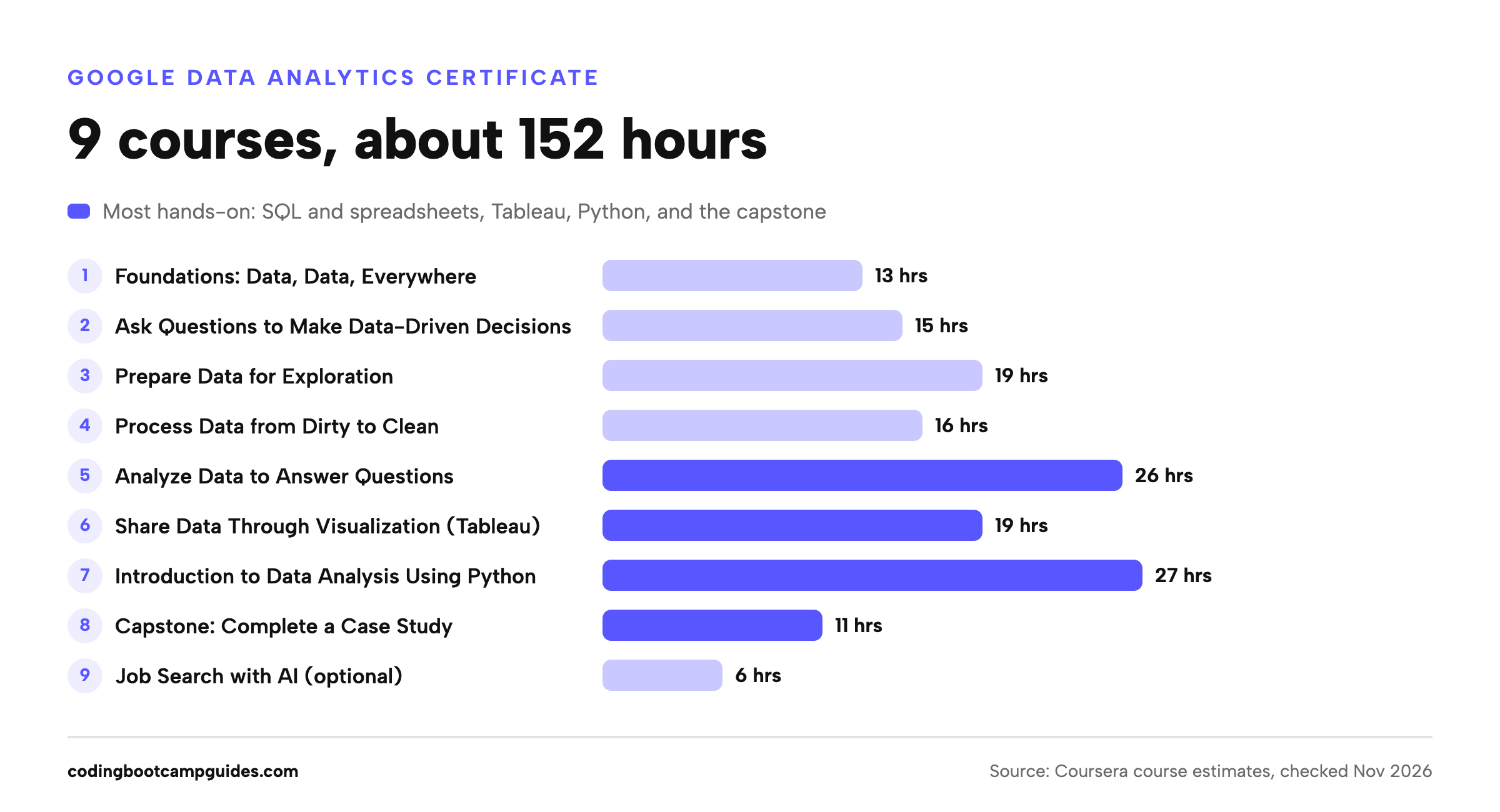
The courses follow the steps of a real analysis: ask, prepare, process, analyze, share, and act. Hours are Coursera’s own estimates.
| # | Course | What it covers | Hours |
|---|---|---|---|
| 1 | Foundations: Data, Data, Everywhere | What analysts do, the data life cycle, and a first look at spreadsheets and SQL | 13 |
| 2 | Ask Questions to Make Data-Driven Decisions | Defining problems, asking useful questions, and working with stakeholders | 15 |
| 3 | Prepare Data for Exploration | Data types, bias and credibility, databases, and pulling data with SQL | 19 |
| 4 | Process Data from Dirty to Clean | Data integrity and cleaning data in spreadsheets and SQL | 16 |
| 5 | Analyze Data to Answer Questions | Sorting, filtering, pivot tables, lookups, SQL joins, and calculations | 26 |
| 6 | Share Data Through the Art of Visualization | Tableau dashboards, data storytelling, and presenting findings | 19 |
| 7 | Introduction to Data Analysis Using Python | Python basics for loading, cleaning, analyzing, and charting data | 27 |
| 8 | Google Data Analytics Capstone: Complete a Case Study | An end-to-end case study you can show employers | 11 |
| 9 | Accelerate Your Job Search with AI | Optional: résumés, job search plans, and interview practice using AI tools | 6 |
The strongest parts are courses 5 through 8, where you actually analyze data, build dashboards, and finish a case study. The first two courses are slower and mostly about process and vocabulary. They’re useful for interviews, but most people find them the least engaging part.
How much does the Google Data Analytics Certificate cost?
Coursera charges a monthly subscription, not a flat fee, so your total depends on how fast you finish:
| Pace | Time to finish | Total cost |
|---|---|---|
| About 15–20 hours a week | About 2–3 months | About $100–$150 |
| About 10 hours a week | About 4–6 months | About $200–$300 |
| A few hours a week | 9–12 months | About $450–$600 |
- Start with the 7-day free trial and work through as much of course 1 as you can before you’re billed.
- Coursera Plus includes this certificate and almost everything else on Coursera. It was on sale for $239 a year when we checked. That’s worth it only if you plan to take several programs, for example this one plus Google’s Advanced Data Analytics or Business Intelligence certificate.
- Financial aid is available through Coursera, and some employers, libraries, and workforce programs sponsor access for free.
- Watch the extras: enrolling includes a 3-month Google AI Pro trial that requires a payment method and renews at $19.99 a month unless you cancel.
How long does it really take?
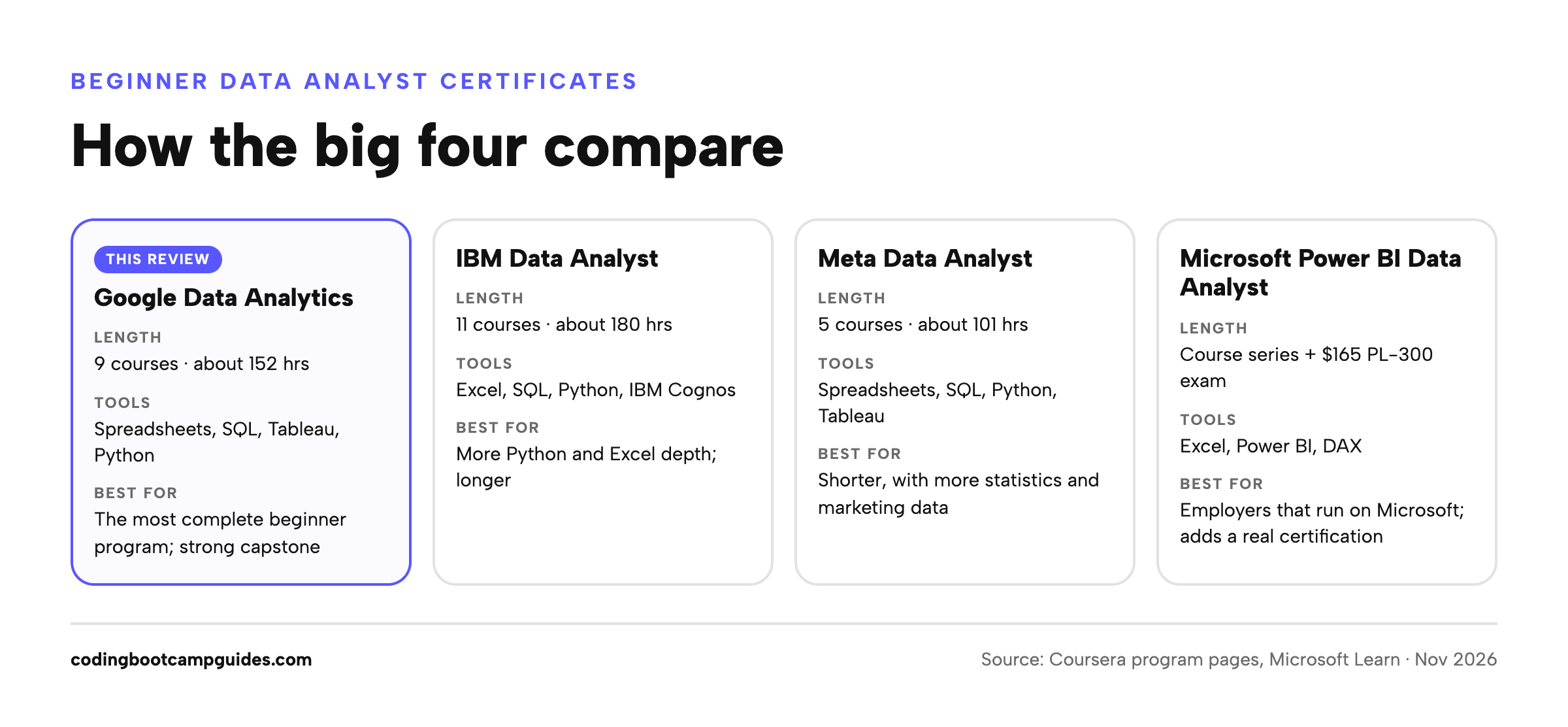
The official numbers don’t agree. Coursera’s course estimates add up to about 152 hours, Coursera’s program page mentions “over 180 hours of instruction,” and Google’s own FAQ says “around 240 hours total.” Google says 3–6 months; Coursera lists 6 months at 10 hours a week. If spreadsheets and SQL are new to you, plan on the higher end. A realistic plan for someone with a full-time job is 5–6 months at 8–10 hours a week, plus extra time for the capstone if you do it properly.
Will it get you a job?
This is where the marketing and the hiring market diverge, so it’s worth being precise.
The case for it. Data work is growing. The U.S. Bureau of Labor Statistics doesn’t track “data analyst” as its own job, but its closest category, data scientists, is projected to grow 35% from 2025 to 2035, with about 24,800 openings a year and a median salary of $120,230 in May 2025. Google says more than 150 U.S. employers, including Deloitte, Target, Verizon, Wells Fargo, and Google itself, have joined its employer consortium and consider graduates. The capstone gives you a real project to discuss in interviews.
The reality check.
- Google’s salary figure isn’t a starting salary. The “$97,000 median” on Google’s page covers data analytics jobs with 0–5 years of experience, and Coursera’s “$100,096 median entry-level salary” comes from job postings, not from what graduates earn (both from Lightcast). First analyst jobs usually pay less.
- Many employers still want a degree. BLS lists a bachelor’s degree as the typical entry-level education for data scientists, and many analyst postings ask for one. Without a degree, your portfolio has to carry more weight.
- Millions of people hold this certificate. With nearly 4 million enrollments, listing it on your résumé won’t set you apart. Your own projects and strong SQL will.
- The outcome statistics are self-reported. Coursera cites a 2022 survey in which 75% of U.S. graduates reported a positive career outcome (a new job, promotion, or raise) within six months. That counts promotions and raises, and it covers only graduates who answered the survey.
Google Data Analytics vs. IBM, Meta, and Microsoft
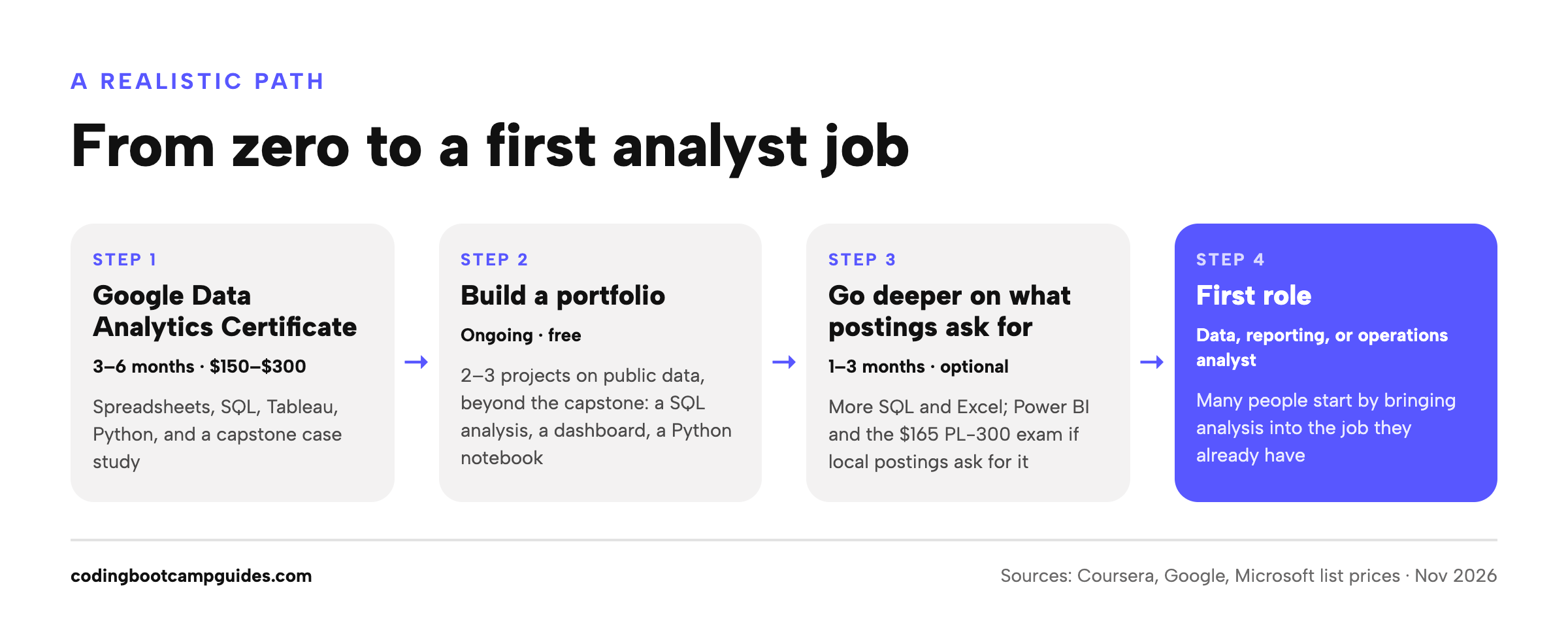
All four teach the same core job. The differences are length, tools, and which employers they line up with. Google’s is the most complete for a true beginner, and its capstone is the best portfolio starter. IBM’s goes deeper on Excel and Python but takes longer. Meta’s is the shortest. Microsoft’s Power BI track is the one to pick if employers near you run on Microsoft, because it leads to the PL-300 exam, a real certification rather than a course certificate.
Pros and cons
| Pros | Cons |
|---|---|
| Cheap: usually $150–$300 in total | Not enough on its own for most analyst job postings |
| No experience or degree needed | The first two courses are slow and conceptual |
| Covers the core toolkit: spreadsheets, SQL, Tableau, and now Python | The SQL and Python are introductory; you’ll need more practice to pass technical interviews |
| A capstone case study for your portfolio | Millions of people hold it, so it doesn’t stand out by itself |
| Google’s employer consortium, coaching, and job board | The consortium considers graduates; it doesn’t guarantee interviews |
| Leads into Google’s Advanced Data Analytics and Business Intelligence certificates | No live instruction or mentor; you need self-discipline |
From Michael, Hack Reactor ’16: If you’re curious about data work, this is the cheapest serious way to find out whether you enjoy it. Just don’t stop at the certificate. Everyone applying for the same junior analyst jobs has it too. What separates people is one or two projects of their own, built on data they found and cared about, and SQL they can write without looking things up. One of the best projects you can do doesn’t need a new job at all: use what you learn to analyze something in the job you already have, like automating a weekly report or measuring where a process slows down. That gives you a résumé bullet and an interview story about real data analysis that improved how your team works.
Who should take it, and who should skip it
Good fit: career changers who like spreadsheets, puzzles, or numbers and want a cheap, structured start; people in operations, marketing, finance, or customer support who want to add analysis to their current job; anyone deciding between data analytics and another tech path before spending more money.
Skip it or start elsewhere: if you already use SQL and a BI tool at work, start with Google’s Advanced Data Analytics or Business Intelligence certificate instead. If your target employers use Microsoft tools, the Power BI track and PL-300 exam may serve you better. If you need live instruction and accountability, look at a data analytics bootcamp or a tuition-free program first.
What to do after you finish
- Polish the capstone and publish it on GitHub, Kaggle, or a simple portfolio site.
- Build one or two projects of your own on public data that interests you: a SQL analysis, a Tableau or Power BI dashboard, and a Python notebook.
- Practice SQL until it’s second nature. Most analyst interviews include a SQL test.
- Go further if you need to. Google’s Business Intelligence certificate (4 courses, about 2 months) adds data modeling and dashboards; the Advanced Data Analytics certificate (7 courses, about 6 months) adds statistics, regression, and machine learning in Python.
- Apply widely, including operations, reporting, and business analyst roles, and look for analysis work inside your current employer.
Alternatives to the Google Data Analytics Certificate
| Option | Cost | Best for |
|---|---|---|
| IBM Data Analyst (Coursera or edX) | Coursera subscription; 11 courses, about 180 hours | More Excel and Python depth |
| Meta Data Analyst (Coursera) | Coursera subscription; 5 courses, about 101 hours | A shorter program with more statistics |
| Microsoft Power BI Data Analyst + PL-300 | Coursera subscription + $165 exam | Employers that run on Microsoft tools |
| Google Advanced Data Analytics | Coursera subscription; 7 courses, about 6 months | The next step: statistics, Python, and machine learning |
| freeCodeCamp Data Analysis with Python | Free | Learning Python for data on a zero budget |
| Data analytics bootcamps | About $5,000–$15,000 | Live instruction, career services, and accountability |
See every option side by side in our professional certificates directory, certifications directory, and other paths into tech.
Google Data Analytics Certificate FAQ
Is the Google Data Analytics Certificate worth it?
Yes, as a low-cost way to learn the fundamentals and find out whether you like data work. It’s not worth it if you expect the certificate alone to land an analyst job; plan to add portfolio projects and more SQL practice.
How much does it cost?
$49 a month on Coursera in the U.S. and Canada, after a 7-day free trial. Most people finish for $150–$300. Financial aid is available.
How long does it take?
Google says 3–6 months; Coursera lists 6 months at 10 hours a week. Beginners with full-time jobs should plan on 5–6 months.
Does it still teach R?
No. Course 7 now teaches Python (“Introduction to Data Analysis Using Python”). Some pages and older reviews still mention R, but the current course list uses Python.
Do I need to know math or coding?
No coding experience is needed, and Google says high-school math is enough. The SQL and Python are taught from scratch.
Do employers recognize it?
More than 150 U.S. employers in Google’s consortium have committed to considering graduates. Most employers, though, hire based on skills they can test, especially SQL, and on portfolio work, so treat the certificate as a starting point.
Sources
- Coursera: Google Data Analytics Professional Certificate (courses, hours, enrollment, ratings, Lightcast salary data), checked November 11, 2026
- Google: Data Analytics Certificate (tools, employer consortium, CareerCircle, hours FAQ)
- U.S. Bureau of Labor Statistics: Data Scientists
- Coursera program pages for IBM Data Analyst, Meta Data Analyst, Google Advanced Data Analytics, and Google Business Intelligence