By Michael Stromberg, Hack Reactor graduate (2016) · Last verified November 10, 2026
The Google Cybersecurity Certificate is one of the most popular entry-level security programs anywhere: more than 1.6 million people have enrolled on Coursera. It costs about $49 a month, needs no experience or degree, and teaches the day-to-day work of a junior security analyst: Linux, SQL, Python, SIEM tools, and incident response. This review covers what’s in it, what it really costs, how long it takes, and the part most reviews skip: what it takes to turn it into a job.
The short verdict: it’s the best-value starting point for a career changer who wants to find out whether security is for them. On its own, though, it’s rarely enough to get hired. Plan to pair it with CompTIA Security+ and hands-on practice.
Google Cybersecurity Certificate at a glance
| Built by | Google, hosted on Coursera |
| Cost | $49 a month in the U.S. and Canada after a 7-day free trial. Most people pay $150–$300 in total. Financial aid is available |
| Length | 9 courses. Coursera’s course estimates add up to about 132 hours; Google says 3–6 months at under 10 hours a week |
| Level | Beginner; no experience or degree required |
| Tools you’ll use | Python, Linux, SQL, Chronicle and Splunk (SIEM), Suricata (IDS), Wireshark and tcpdump |
| Prepares you for | Entry-level security analyst and SOC analyst roles, and the CompTIA Security+ exam |
| Extras | Discounted Security+ exam and training, up to 9 recommended college credits (ACE), access to Google’s 150+ company employer consortium and job board |
| Rating | 4.8 from about 70,000 Coursera reviews |
What it is and who built it
The certificate is one of Google’s Career Certificates, a set of online programs designed by Google employees to prepare beginners for specific entry-level jobs. It’s self-paced and fully online, and it runs on Coursera, which handles enrollment and billing. Google has added AI training since launch. Course 8 covers using AI to read security frameworks, review code, and prioritize alerts, and an optional ninth course covers using AI in a job search.
What you’ll learn: the 9 courses
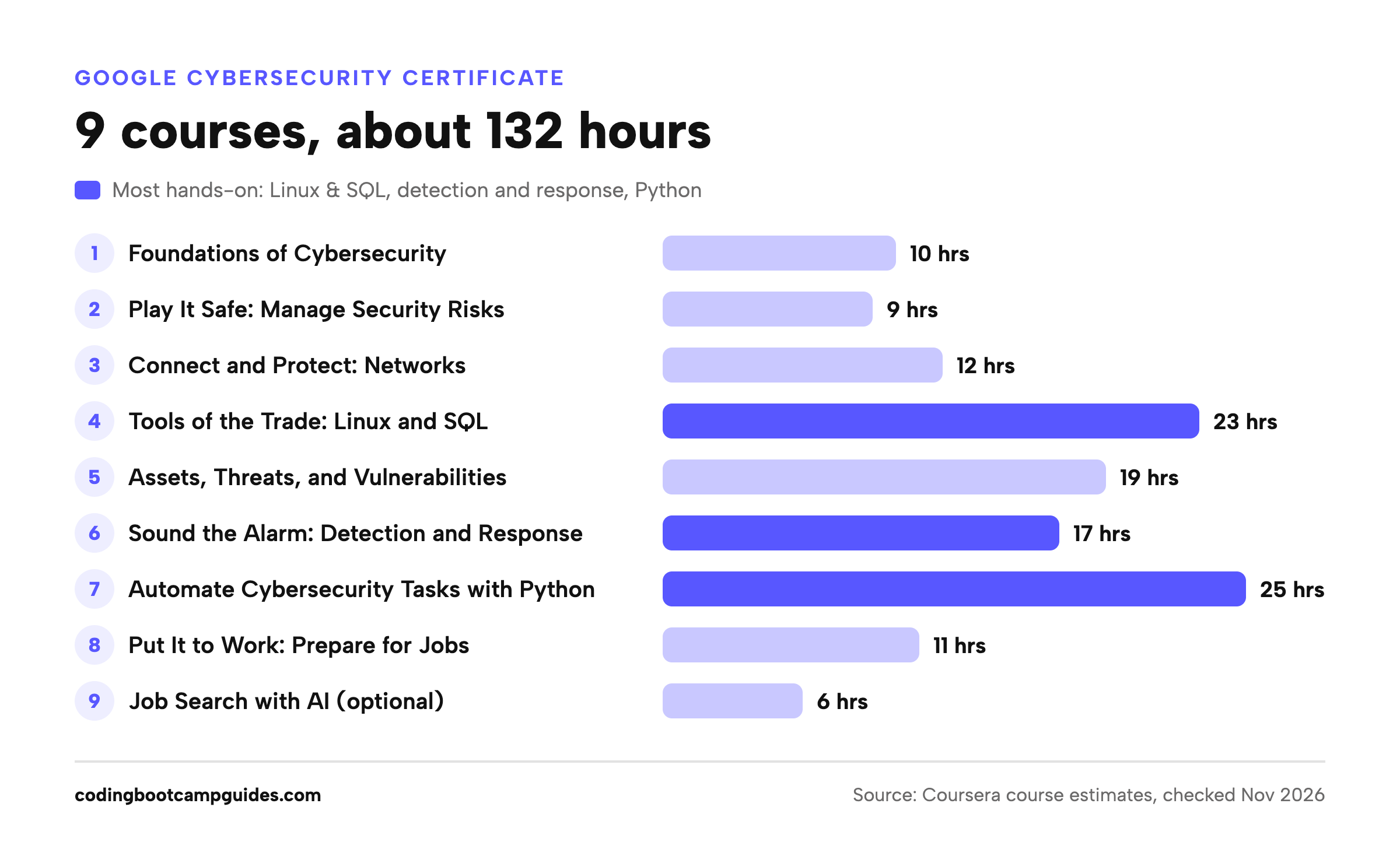
The courses build in order, from security concepts to hands-on tools and then to the job search. Hours are Coursera’s own estimates.
| # | Course | What it covers | Hours |
|---|---|---|---|
| 1 | Foundations of Cybersecurity | Core concepts, common threats, and what a security analyst does | 10 |
| 2 | Play It Safe: Manage Security Risks | Frameworks and controls such as NIST CSF and the CIA triad; using a SIEM | 9 |
| 3 | Connect and Protect: Networks and Network Security | How networks work, network attacks, and hardening | 12 |
| 4 | Tools of the Trade: Linux and SQL | The Linux command line and querying databases with SQL | 23 |
| 5 | Assets, Threats, and Vulnerabilities | Asset management, threat modeling, and vulnerability assessment | 19 |
| 6 | Sound the Alarm: Detection and Response | Incident response, packet analysis, IDS (Suricata), and SIEM tools (Splunk, Chronicle) | 17 |
| 7 | Automate Cybersecurity Tasks with Python | Python scripting for common security tasks | 25 |
| 8 | Put It to Work: Prepare for Cybersecurity Jobs | Escalation, communication, using AI in security work, and job readiness | 11 |
| 9 | Accelerate Your Job Search with AI | Optional: résumés, job search plans, and interview practice using AI tools | 6 |
The strongest parts are courses 4, 6, and 7. They’re where you actually use the tools a junior analyst works with. The early courses are mostly concepts and vocabulary, which is useful for interviews and for Security+, but you won’t feel like you’re “doing security” until the middle of the program.
How much does the Google Cybersecurity Certificate cost?
Coursera charges a monthly subscription, not a flat fee, so your total depends on how fast you finish:
| Pace | Time to finish | Total cost |
|---|---|---|
| About 10 hours a week | About 3 months | About $150 |
| About 7 hours a week | About 5–6 months | About $250–$300 |
| A few hours a week | 9–12 months | About $450–$600 |
- Start with the 7-day free trial and work through as much of course 1 as you can before you’re billed.
- Coursera Plus includes this certificate and almost everything else on Coursera. It’s worth it only if you plan to take several programs, for example this one plus the IBM or Microsoft security certificates.
- Financial aid is available through Coursera, and some employers, libraries, and workforce programs sponsor access for free.
- Watch the extras: enrolling includes a 3-month Google AI Pro trial that requires a payment method and renews at $19.99 a month unless you cancel.
- Budget for Security+ separately. The exam costs $439 at CompTIA’s list price. Google graduates get a discount, but Google doesn’t publish the amount, so check at checkout.
How long does it really take?
Google says 3–6 months at under 10 hours a week, and Coursera lists six months at 7 hours a week. The individual course estimates add up to about 132 hours, though Coursera’s program page also cites 170 hours of instruction. If you have no IT background, plan on the higher number: the Linux, SQL, and Python courses take beginners longer than the estimates suggest. A realistic plan for someone with a full-time job is 4–6 months at 8–10 hours a week.
Will it get you a job?
This is where Google’s marketing and the hiring market diverge, so it’s worth being precise.
The case for it. Security work is growing. The U.S. Bureau of Labor Statistics projects information security analyst jobs to grow 21% from 2025 to 2035, with about 14,100 openings a year and a median salary of $129,180 in May 2025. Google says more than 150 U.S. employers, including American Express, Deloitte, Mandiant, T-Mobile, and Walmart, have joined its employer consortium and consider graduates. In ISC2’s 2025 survey of hiring managers, 89% said they would consider candidates whose only qualification was an entry-level cybersecurity certification.
The reality check.
- It’s an entry point, not a credential most postings require. Entry-level security job postings commonly list CompTIA Security+ as a requirement; course certificates rarely appear there. Security+ is an approved baseline certification for many U.S. Department of Defense and contractor roles.
- Google’s salary figure isn’t a starting salary. The “$120,000+ median” on Google’s page covers all cybersecurity jobs with 0–5 years of experience (Lightcast, 2025). First jobs, such as SOC tier 1 analyst or IT help desk with security duties, usually pay less.
- Employers like prior IT experience. In the same ISC2 survey, 90% of hiring managers said they would consider candidates with prior IT work experience. Many people reach security through a help desk or IT support job first.
- The outcome statistics are self-reported. Coursera cites a 2022 survey in which 75% of U.S. graduates reported a positive career outcome (a new job, promotion, or raise) within six months. That counts promotions and raises, and it covers only graduates who answered the survey.
Google Cybersecurity Certificate vs. CompTIA Security+
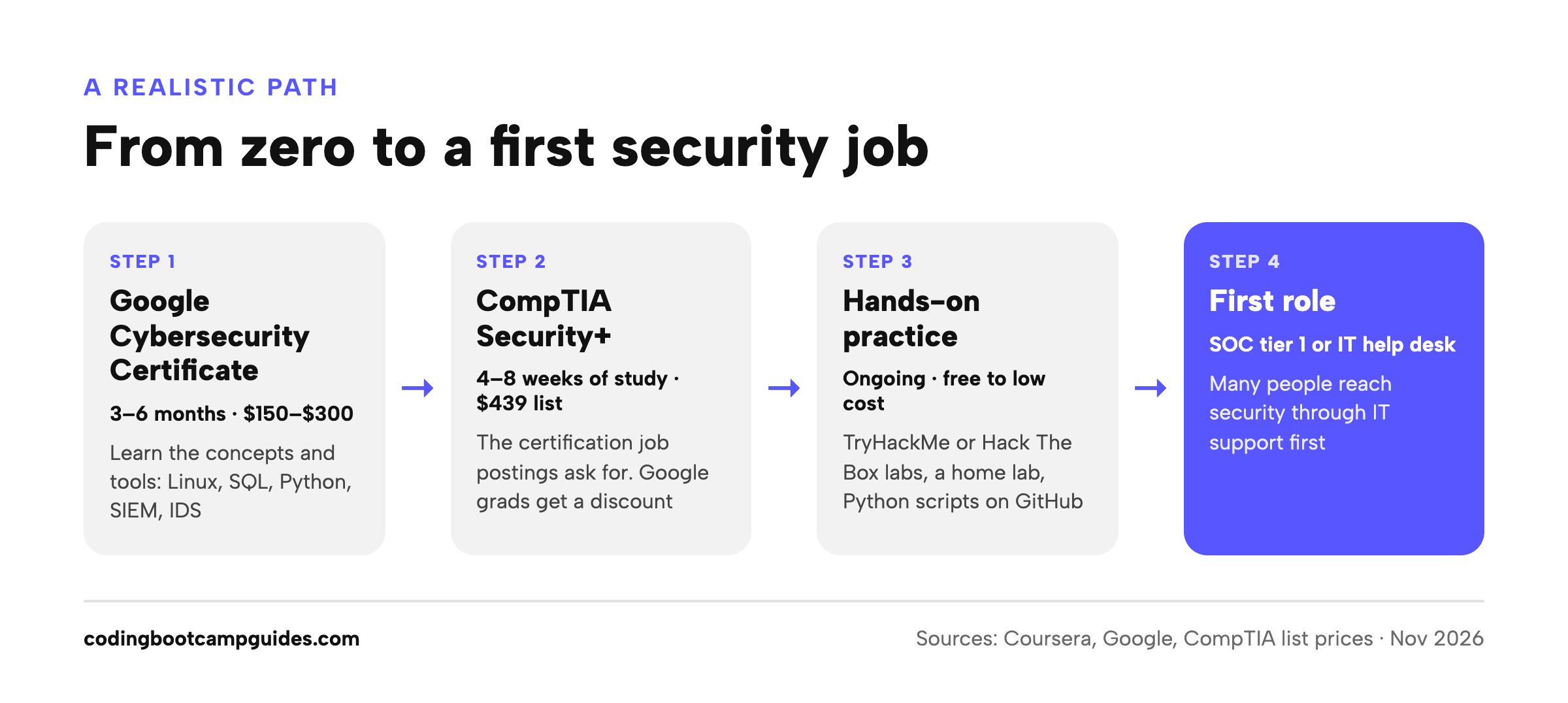
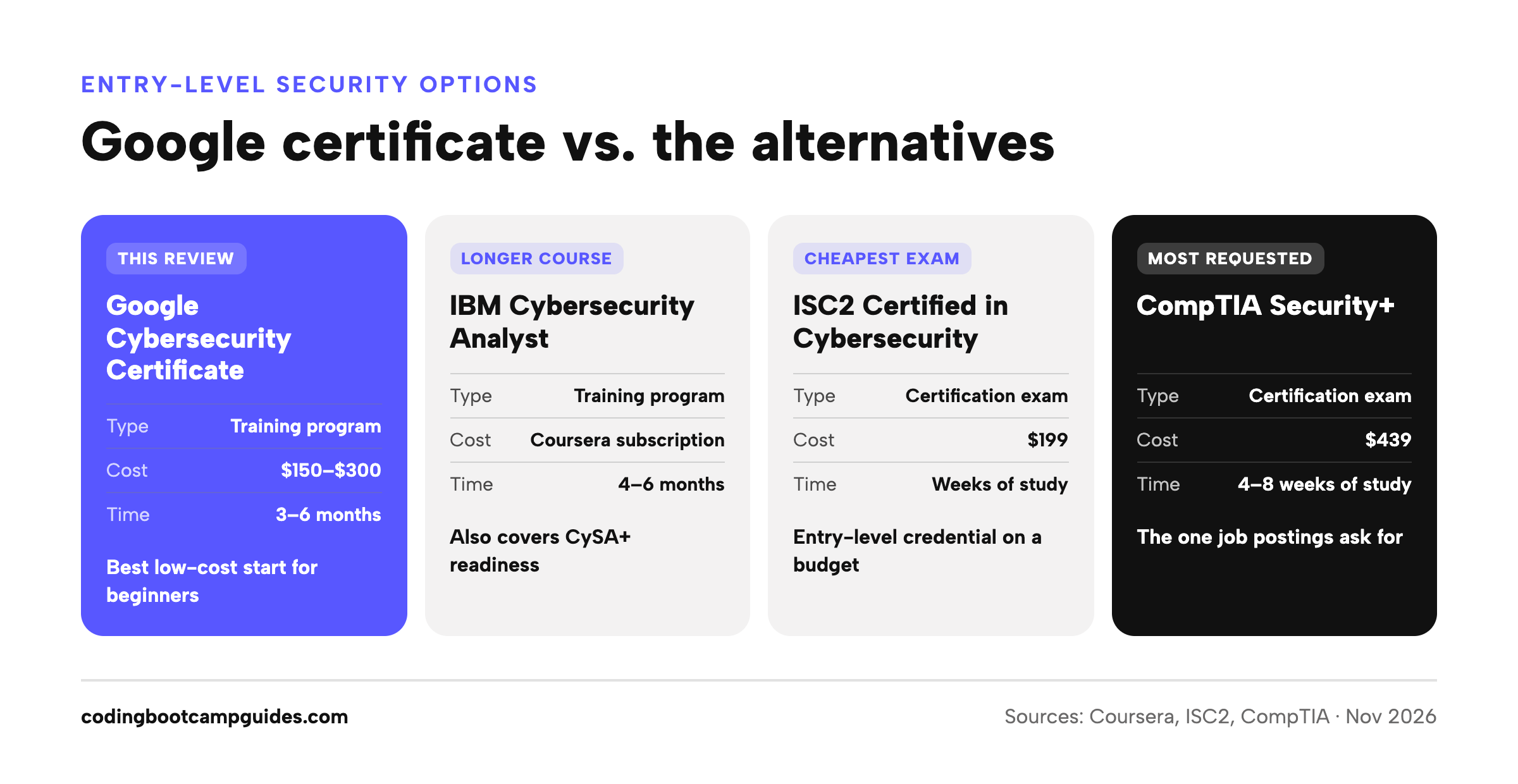
They aren’t competitors; they’re two halves of the same plan. The Google certificate is a training program that teaches you the material and the tools. Security+ is a certification exam that proves you meet an industry standard, and it’s the one many employers filter for. Google designed its program to prepare you for Security+. If you complete both, you earn a dual credential and get discounted exam access. The most cost-effective route for most beginners is to finish the Google certificate, then spend 4–8 weeks on Security+ practice tests before taking the exam.
Pros and cons
| Pros | Cons |
|---|---|
| Cheap: usually $150–$300 in total | Not enough on its own for most security job postings |
| No experience or degree needed | Mostly video and quizzes; hands-on labs are limited compared with TryHackMe or a bootcamp |
| Real tools: Linux, SQL, Python, Splunk, Chronicle, Suricata, Wireshark | No live instruction or mentor; you need self-discipline |
| Prepares you for Security+, with an exam discount | Security+ costs $439 at list price on top |
| Google’s employer consortium and job board | The consortium considers graduates; it doesn’t guarantee interviews |
| Up to 9 recommended college credits | Colleges decide whether to accept the credit |
From Michael, Hack Reactor ’16: For $150 to $300, this is the cheapest serious way to find out whether you like security work before you spend thousands on a bootcamp. Treat it as step one of three. Finish the certificate, pass Security+, and build a small portfolio of hands-on work: write-ups of TryHackMe rooms, a home lab, a Python script that parses logs. That combination is what gets interviews, and you’ll still have spent less than a tenth of what a cybersecurity bootcamp costs.
Who should take it, and who should skip it
- Good fit: career changers with no IT background who want a cheap, structured introduction to security; IT support and help desk workers who want to move into security; anyone planning to take Security+ who wants guided preparation first.
- Skip it or start elsewhere: if you already hold Security+, much of the content will overlap. If you need live instruction and accountability, consider a bootcamp or a free program like Per Scholas. If you want penetration testing specifically, hands-on platforms like TCM Security or Hack The Box go deeper.
What to do after you finish
- Take CompTIA Security+ while the material is fresh. Use your graduate discount.
- Get hands-on. Work through beginner paths on TryHackMe or Hack The Box and write up what you learn.
- Build one or two portfolio projects: a home lab with a SIEM, or Python scripts that automate a security task. Put them on GitHub.
- Apply widely, including IT support roles. A help desk job with security exposure is a common first step into a SOC.
Alternatives to the Google Cybersecurity Certificate
| Option | Cost | Best for |
|---|---|---|
| IBM Cybersecurity Analyst (Coursera or edX) | Coursera subscription; about 4–6 months | A longer course (14 courses, about 175 hours) that also covers CySA+ exam readiness |
| Microsoft Cybersecurity Analyst (Coursera) | Coursera subscription | People targeting employers that run on Microsoft security tools |
| ISC2 Certified in Cybersecurity (CC) | $199 exam | The cheapest recognized entry-level security certification |
| CompTIA Security+ | $439 exam | The certification employers ask for most often; take it after this certificate |
| Cybersecurity bootcamps | About $10,000–$15,000 | Live instruction, career services, and accountability |
| Per Scholas | Free | Full-time, instructor-led training with employer connections |
See every option side by side in our professional certificates directory and certifications directory.
Google Cybersecurity Certificate FAQ
Is the Google Cybersecurity Certificate worth it?
Yes, as a low-cost first step, especially if you follow it with CompTIA Security+ and hands-on practice. It’s not worth it if you expect the certificate alone to land a security analyst job.
How much does it cost?
$49 a month on Coursera in the U.S. and Canada, after a 7-day free trial. Most people finish for $150–$300. Financial aid is available.
How long does it take?
Google says 3–6 months at under 10 hours a week. Beginners with full-time jobs should plan on 4–6 months.
Does it include the Security+ exam?
No. It prepares you for Security+ and gives graduates discounted access to the exam and training, but you register for and pay for the exam separately through CompTIA.
Do I need to know how to code?
No. Course 7 teaches the Python you need from scratch, and course 4 teaches Linux and SQL basics.
Do employers recognize it?
More than 150 U.S. employers in Google’s consortium have committed to considering graduates. Most job postings, though, ask for certifications like Security+ or for prior IT experience, so pair the certificate with one of those.
Sources
- Coursera: Google Cybersecurity Professional Certificate (courses, hours, price, ratings, enrollment), checked November 10, 2026
- Google: Cybersecurity Certificate (tools, employer consortium, Security+ discount, Lightcast salary data)
- U.S. Bureau of Labor Statistics: Information Security Analysts
- ISC2: early-career hiring research (2025)
- Coursera: IBM Cybersecurity Analyst