By Michael Stromberg, Hack Reactor graduate (2016) · Last verified November 6, 2026
Hack Reactor is one of the best-known coding bootcamps in the U.S., and it’s a very different program today than the one most reviews describe. I graduated from Hack Reactor in 2016 and have worked in software development ever since. This guide covers Hack Reactor as it is today: what it costs, how admissions works, what you’ll learn, and whether it’s worth it.

Hack Reactor at a glance
| Programs | Full-Time Beginner Bootcamp (16 weeks) and Part-Time Beginner Bootcamp (30 weeks) |
| Format | Live online; no in-person campus |
| Tuition | Full-time: $19,480 ($16,980 after the $2,500 Merit Scholarship). Part-time: $16,500 |
| Prior experience needed | None |
| Admissions | Online application + 15-minute CCAT aptitude test; 18–20 hours of Course Primers after you enroll |
| Payment options | Pay upfront, split 50/50, loans (Climb Credit, Clasp), VA funding, scholarships |
| Owner | Galvanize (acquired Hack Reactor in 2018), which is owned by Stride |
| Not available to residents of | New Mexico, Nevada, North Dakota |
What’s changed at Hack Reactor
If you’ve read older reviews, including earlier versions of this guide, these are the changes that matter:
- The 12-week Intermediate program is gone. Hack Reactor built its reputation on an advanced “20 to 100” immersive for people who already code. Today it offers beginner programs only.
- Admissions is far easier to get through. The live technical interview (the Technical Admissions Assessment) is gone. You now submit an application, take the CCAT, and complete self-paced prep work.
- The part-time program is Tech Elevator’s, a sister bootcamp under the same parent company, and it teaches Tech Elevator’s Java-based curriculum, not Hack Reactor’s. Hack Reactor shut down its original part-time program in 2023.
- The full-time curriculum is Python-first, with AI built in. Students prompt an LLM from day one, take a dedicated Generative AI Literacy unit, and use GitHub Copilot in the final team project.
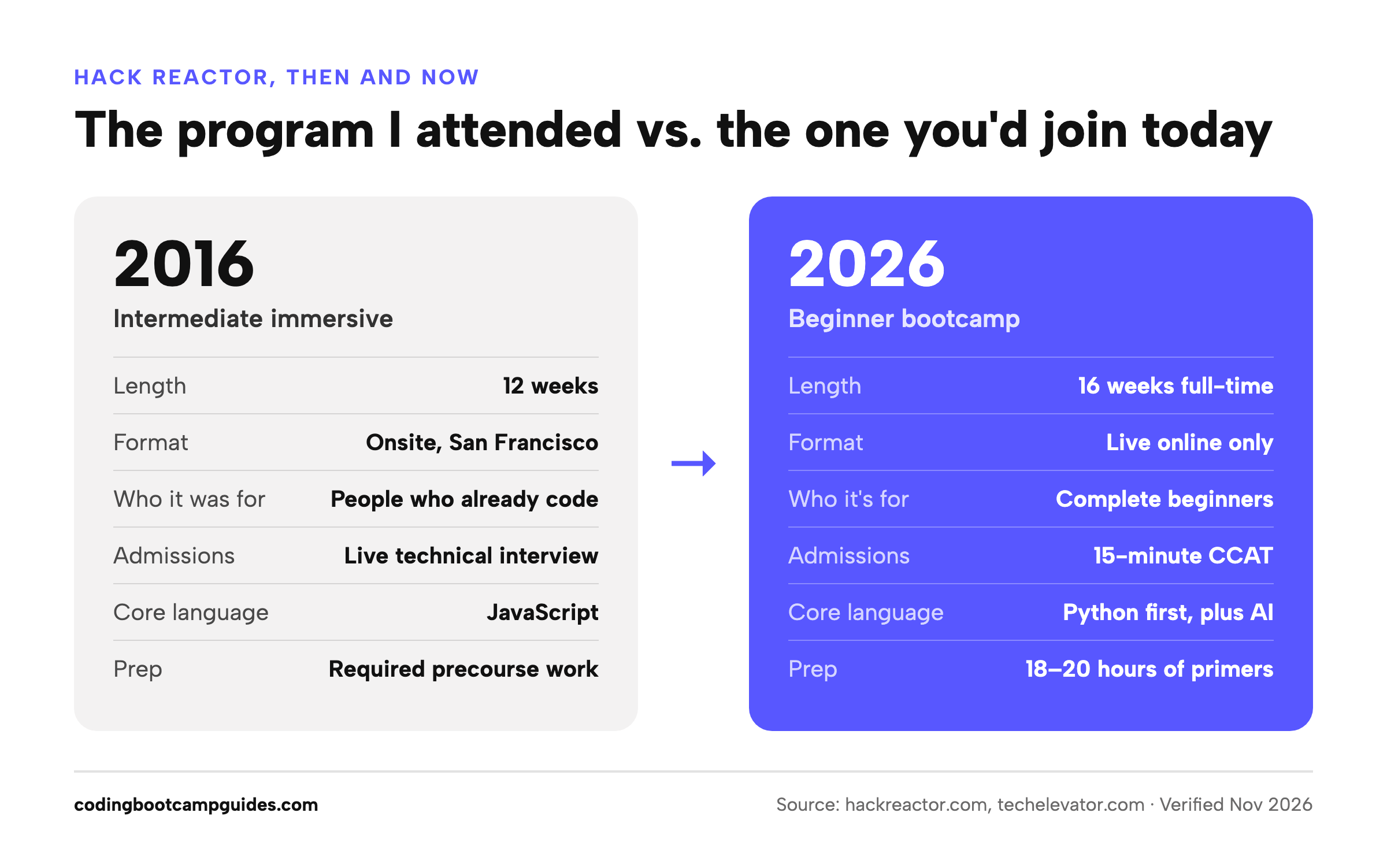
From Michael, Hack Reactor ’16: I attended the original 12-week onsite immersive in San Francisco, back when getting in meant passing a live technical interview. That bar meant my classmates arrived already able to code, and the program moved accordingly: a new technology every two days. Today’s beginner programs serve a different student, someone starting from zero, and the longer 16-week format and Python-first curriculum reflect that. It’s a sensible change, but know what you’re buying: a well-run beginner bootcamp, not the advanced immersive that made Hack Reactor’s name.
How much does Hack Reactor cost?
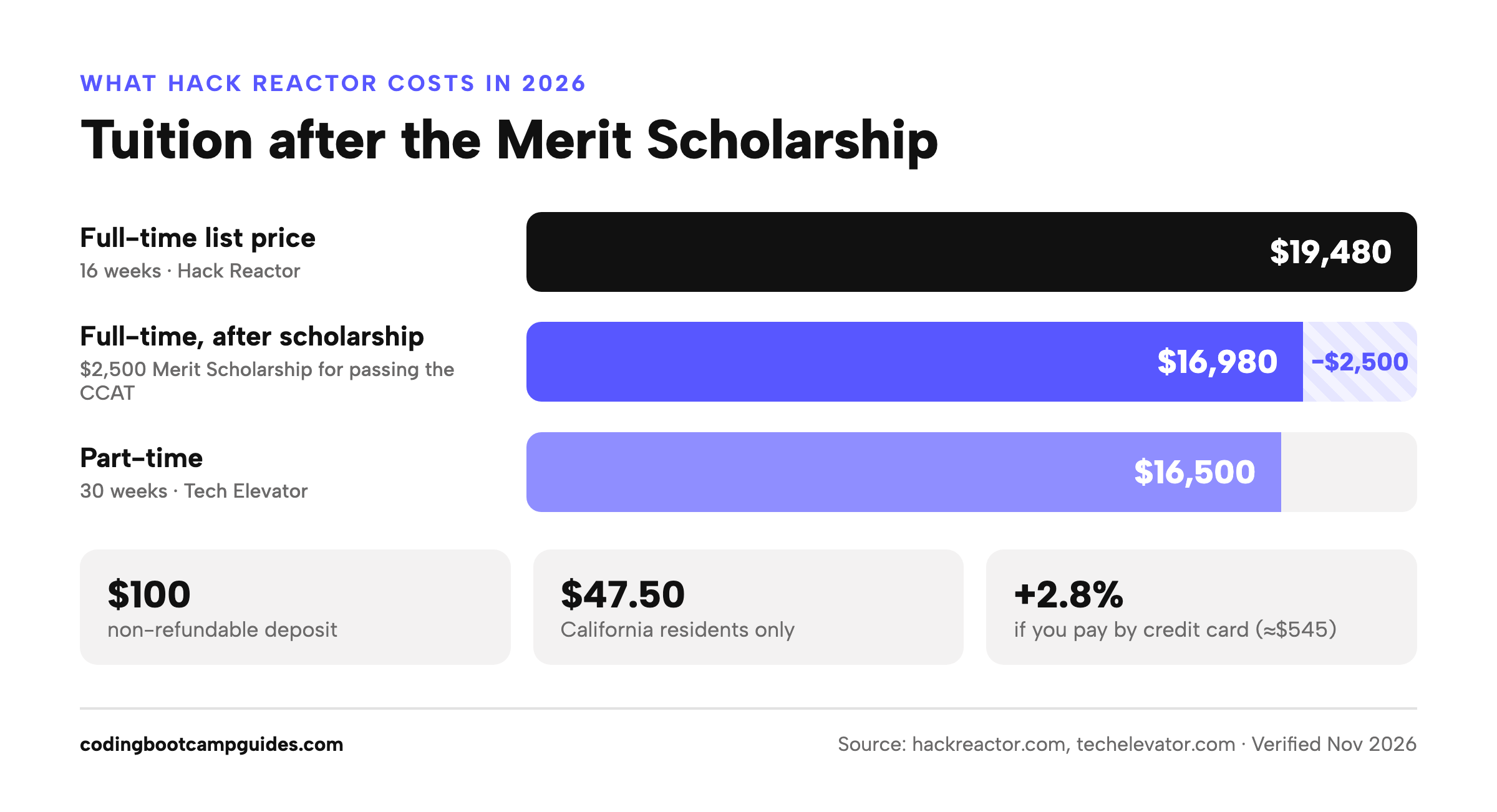
Tuition for the Full-Time Beginner Bootcamp is $19,480. Pass the CCAT and you receive a $2,500 Merit Scholarship, which brings it to $16,980. The Part-Time Beginner Bootcamp, run by Tech Elevator, is $16,500. Either way, you pay a $100 non-refundable deposit when you enroll, and California residents also pay a $47.50 state tuition recovery fee.
Ways to pay
- Upfront: pay in full by your start date.
- Split payment: 50% on your first day and 50% at the program’s midpoint.
- Loans: Climb Credit (co-signer loans) and Clasp’s Payment Protection Loan (no co-signer). With the Clasp loan, fixed monthly payments start only after you leave the program and are earning at least a minimum income. That defers your payments. It doesn’t forgive them if you don’t land a job.
- VA funding and other third-party payment for eligible students.
- Scholarships: a $2,500 Merit Scholarship for every applicant who passes the CCAT, and competitive full-tuition Represent Tech scholarships for people from groups underrepresented in tech. The Represent Tech scholarship includes an asynchronous video interview.
Weighing a loan against the other options? Our guide to how to pay for a coding bootcamp compares employer aid, grants, VET TEC, 0% plans, and bootcamp loans, with the real cost of each.
Paying by card costs extra: credit card payments carry a 2.8% convenience fee, about $545 on full tuition. Bank transfer (ACH) is free.
Refunds: the refund policy depends on your state and is spelled out in your enrollment agreement. Leave after the refund cutoff date and you get nothing back. Read it before you sign.
Before taking on nearly $20,000 in tuition, or a loan, run your numbers through our coding bootcamp break-even calculator. It shows how long a new salary takes to pay back the bootcamp plus the months you’re not earning.
Programs and schedule
Full-Time Beginner Bootcamp (16 weeks)
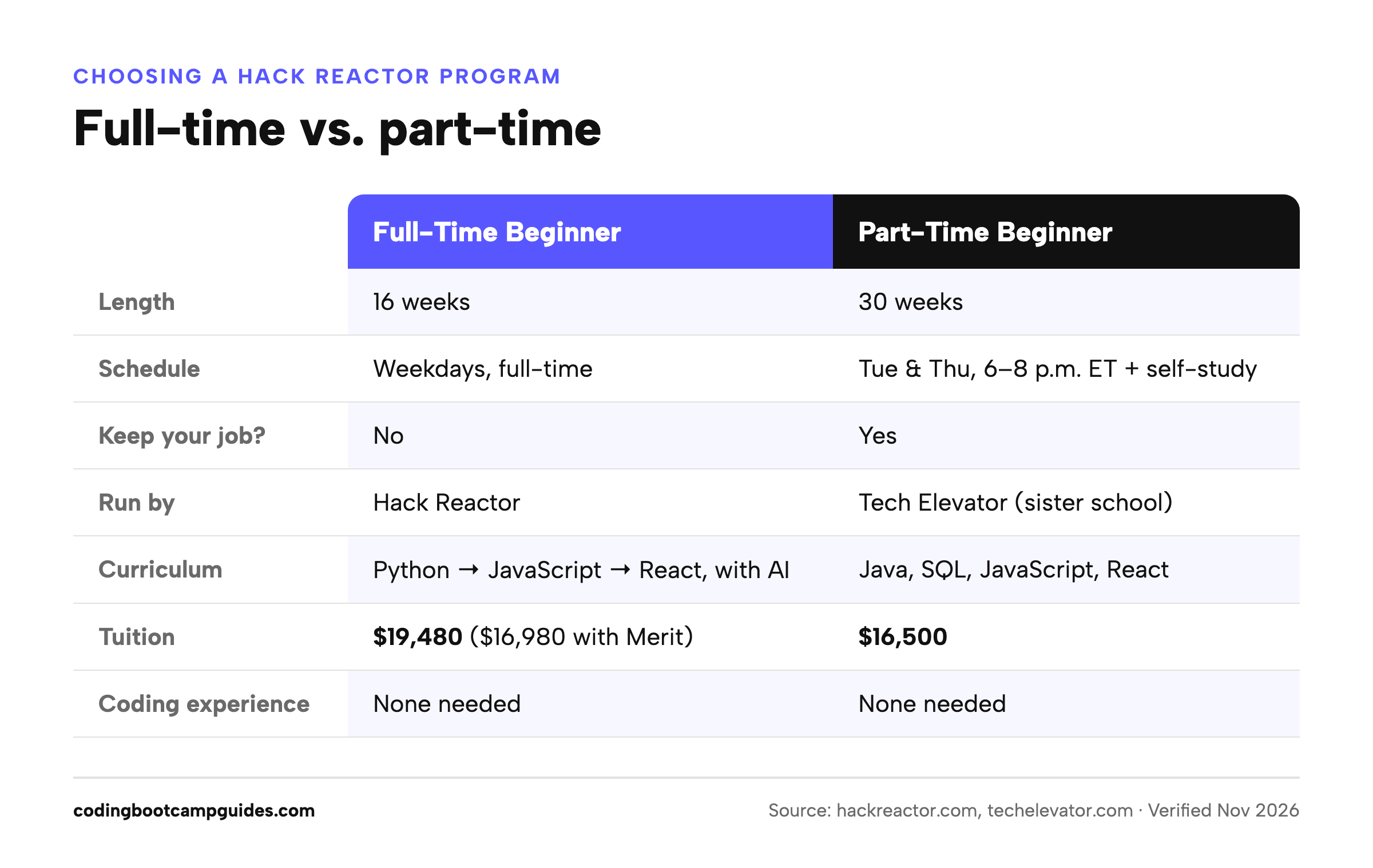
The full-time program runs live online for 16 weeks. Recent cohorts ran February 17 – June 5, 2026 and June 15 – October 1, 2026, and upcoming start dates are in the admissions portal. Treat it as a full-time job. You can’t do it alongside one.
Part-Time Beginner Bootcamp (30 weeks)
The part-time program is run by Tech Elevator and lasts 30 weeks. Live instructor-led sessions are Tuesdays and Thursdays, 6–8 p.m. ET, with independent self-study the rest of the week. Hack Reactor also lists Monday/Wednesday evening and Saturday-morning sections, which vary by cohort. It teaches Tech Elevator’s curriculum: Java, SQL, HTML/CSS, JavaScript, and React. The Python-first curriculum below applies only to the full-time program. The part-time program is built for people who need to keep their job while they learn.
Hack Reactor curriculum
The full-time curriculum has nine units:
- Python Foundations: programming fundamentals, using an LLM as a learning aid from day one
- Databases: PostgreSQL and MongoDB
- Generative AI Literacy: how machines learn, generative AI tools, AI risks and ethics, and writing your own responsible-use policy
- HTML & CSS Basics
- JavaScript Foundations
- Backend Web: building APIs and client-server communication
- Full-Stack Fluency: an independent project you must complete to continue in the program
- React Development: React and Redux, plus integrating RESTful APIs
- Software Engineering Excellence & Exploring GitHub Copilot: WebSockets and FastAPI, Python and Starlette, Nomad and Consul, GitLab Pipelines and CI/CD, GitHub Copilot, and an Agile team project
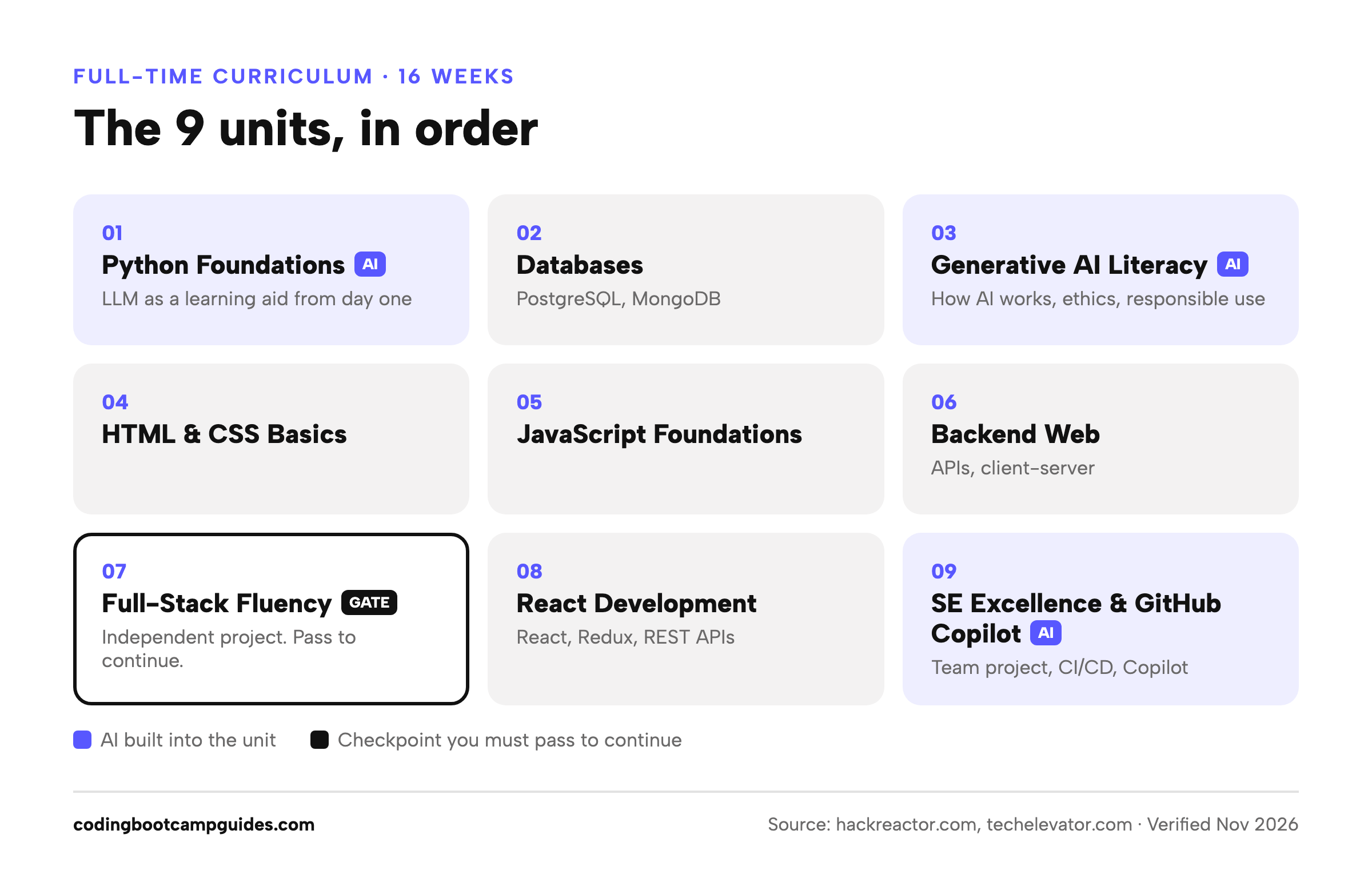
Full-Stack Fluency is a gate: pass it or you don’t continue. Before you enroll, ask admissions exactly what happens if you don’t pass, including what you’d get back in tuition. If you’re building your JavaScript fundamentals ahead of time, our tutorials on var, let, and const, Array.reduce, and recursion cover the concepts that trip people up most.
From Michael, Hack Reactor ’16: I was in class or studying 12 to 14 hours a day, six days a week, for three months straight. The first half ran in two-day sprints: a short lecture to introduce a new technology, then pair programming for the rest of the sprint, trading off as driver and navigator. The second half was group projects, with whiteboarding practice throughout. The pressure peaked at the midterm assessment. I watched classmates burn out, and one who missed a single day to illness fell so far behind that he never caught up. Today’s Full-Stack Fluency checkpoint plays the same role. Don’t count on the Course Primers to get you ready. They review high school math and computer literacy, not coding. Build your programming fundamentals on your own before day one, because once the pace starts there’s no time to catch up.
Hack Reactor admissions: how to get in
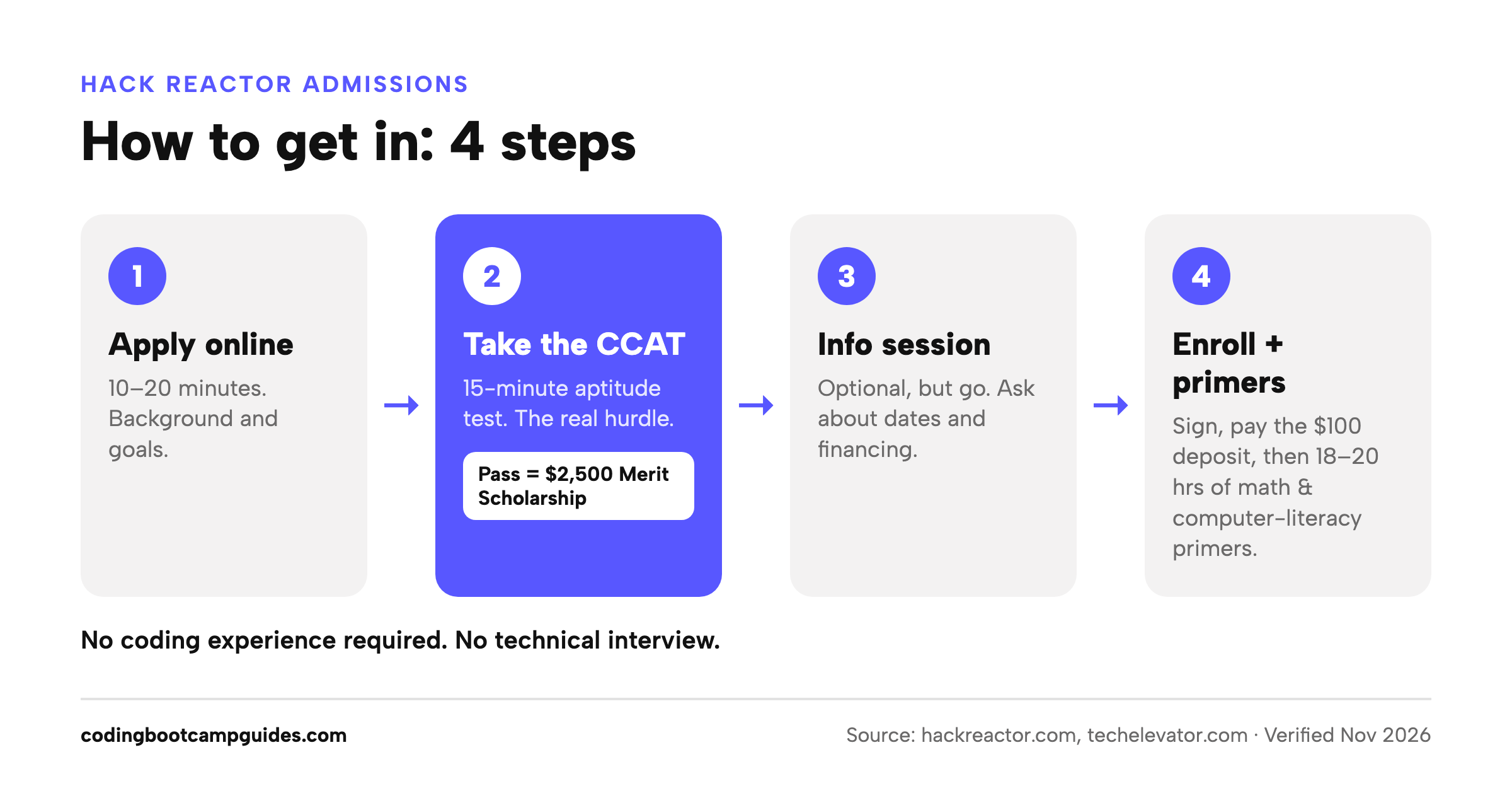
Getting into the full-time program takes four steps:
- Apply online. It takes 10–20 minutes, and you’ll answer questions about your background and goals.
- Take the CCAT, a 15-minute cognitive aptitude test (more on it below). Passing also earns you the $2,500 Merit Scholarship.
- Attend an info session. It’s optional, but go: it’s the best place to ask about the next start date and financing.
- Get accepted, sign, and pay your deposit. Then Hack Reactor sends the Course Primers: 18–20 hours of self-paced material that reviews high school math and computer literacy before your start date.
What is Hack Reactor’s acceptance rate?
Hack Reactor doesn’t publish an acceptance rate, and any number you see online is a guess. Its reputation for being hard to get into came from the old Intermediate program’s technical interview, which many applicants failed on their first try. The beginner programs require no coding experience. Today, the CCAT is the real hurdle.
How to prepare for the CCAT
The Criteria Cognitive Aptitude Test (CCAT) is a 15-minute, timed, multiple-choice test. It measures general problem-solving speed, not coding ability. Expect four kinds of questions:
- Verbal: analogies, synonyms, sentence completion.
- Math: arithmetic, word problems, reading charts and tables.
- Logic: syllogisms and drawing conclusions from statements.
- Spatial and pattern questions: finding the next shape or number in a series.
Very few people finish every question in time, so speed matters as much as accuracy. Take two or three timed practice tests in the CCAT format first. Skip questions that are taking too long and come back to them, and sharpen your mental math: percentages, ratios, and rates.
Career services and job outcomes
Hack Reactor’s career support includes:
- 1:1 coaching through its Pathway Program, during the bootcamp and for six months after graduation, including resume and LinkedIn updates
- Building a GitLab project portfolio
- Mock interviews and job-search workshops
- Help with offer negotiation
- Access to an alumni network
Never used Git? Learn the basics before day one with our Git and GitHub guide for beginners; the same commands work on GitLab.
Outcomes: Hack Reactor states that it does not publish placement data. It collects placement figures only for state regulators. The headline number on its outcomes page, $162,055 in average annual earnings, comes from a 2024 alumni survey of graduates from the last 10 years. That pool includes graduates of the old Intermediate program with years of experience, so it says nothing about where today’s beginner graduates land. Ask admissions for the placement data it reports to your state, including how “placed” is defined and how many graduates were counted. The entry-level developer market is far tougher than it was a few years ago, so ignore old placement numbers from Hack Reactor or any other bootcamp.
Whichever bootcamp you choose, the job search is the hard part. These 10 daily habits for landing a job after a coding bootcamp are where to start.
Is Hack Reactor worth it?
Hack Reactor is a strong fit if you:
- are starting from zero and learn best with live instruction, deadlines, and a cohort;
- can commit 16 weeks full-time, or 30 weeks of evenings or Saturdays;
- have run the break-even math and are comfortable with about $19,500 in tuition or a loan.
Skip it if you:
- already code and want the advanced “20 to 100” experience Hack Reactor was known for; that program no longer exists;
- need a job guarantee or a pay-when-hired plan. Hack Reactor offers neither, and the Clasp loan only delays your payments until you’re earning;
- haven’t tried free resources yet. Spend a few weeks on JavaScript or Python basics first to confirm you enjoy programming before paying for a bootcamp.
Michael’s verdict: For the right person, yes. Hack Reactor took me from six years as a mechanical engineer doing R&D in the hard disk drive industry to a career in software development, and it paid off exactly the way I hoped. The value wasn’t the lectures. It was learning to work autonomously, to communicate like an engineer through constant pair programming and whiteboarding, and to carry a name employers recognize. Go if you’ll treat it as a full-time job and keep studying after you graduate, because the bootcamp is the beginning, not the finish line. Skip it if you’re hoping the program will do the work for you. It won’t, and the pace leaves no room to coast. More in 10 Things I Learned as a Coding Bootcamp Grad.
Comparing schools? App Academy, Hack Reactor’s longtime rival, has changed even more: it’s now part-time, online, and $4,000 upfront. Read the App Academy review for a side-by-side comparison.
Hack Reactor FAQ
Is Hack Reactor still open?
Yes. Hack Reactor is enrolling students in its full-time and part-time beginner bootcamps, both live online.
Is Hack Reactor remote?
Yes. Both programs are delivered live online. There’s no in-person option.
Do I need coding experience?
No. Both programs are built for beginners. After you’re accepted, the Course Primers review high school math and computer literacy. If you can, learn some basic Python or JavaScript on your own before you start.
Does Hack Reactor offer income share agreements or a job guarantee?
No. Your options are paying upfront, a 50/50 split, loans through Climb Credit or Clasp, VA funding, and scholarships. Clasp’s Payment Protection Loan postpones payments until you’re earning a minimum income, but you still owe the full amount.
Who owns Hack Reactor?
Galvanize acquired Hack Reactor in 2018. Galvanize is owned by Stride, the education company that also owns Tech Elevator.
What’s the “Hack Reactor precourse”?
The old Intermediate program required 90–120 hours of precourse work. The beginner programs replace it with Course Primers, 18–20 hours of self-paced material.
Program details, pricing, and admissions steps verified against hackreactor.com and techelevator.com on November 6, 2026.