What Fullstack Academy’s live online software engineering bootcamp costs part-time and full-time, what you learn, what its outcomes data shows, and how the university versions compare.
By Michael Stromberg, Hack Reactor graduate (2016) · Last verified November 18, 2026
Fullstack Academy’s Software Engineering bootcamp is its flagship program: a live online, full-stack JavaScript course that takes beginners from HTML to a React and Node.js capstone in 13 weeks full-time or 22 weeks part-time. Fullstack also markets it as its “coding bootcamp,” “online coding bootcamp,” and “beginner web development bootcamp”; they’re all this program. The same course is sold under the names of a dozen universities. Fullstack’s cybersecurity, data analytics, and AI bootcamps are different programs, so we cover them separately.
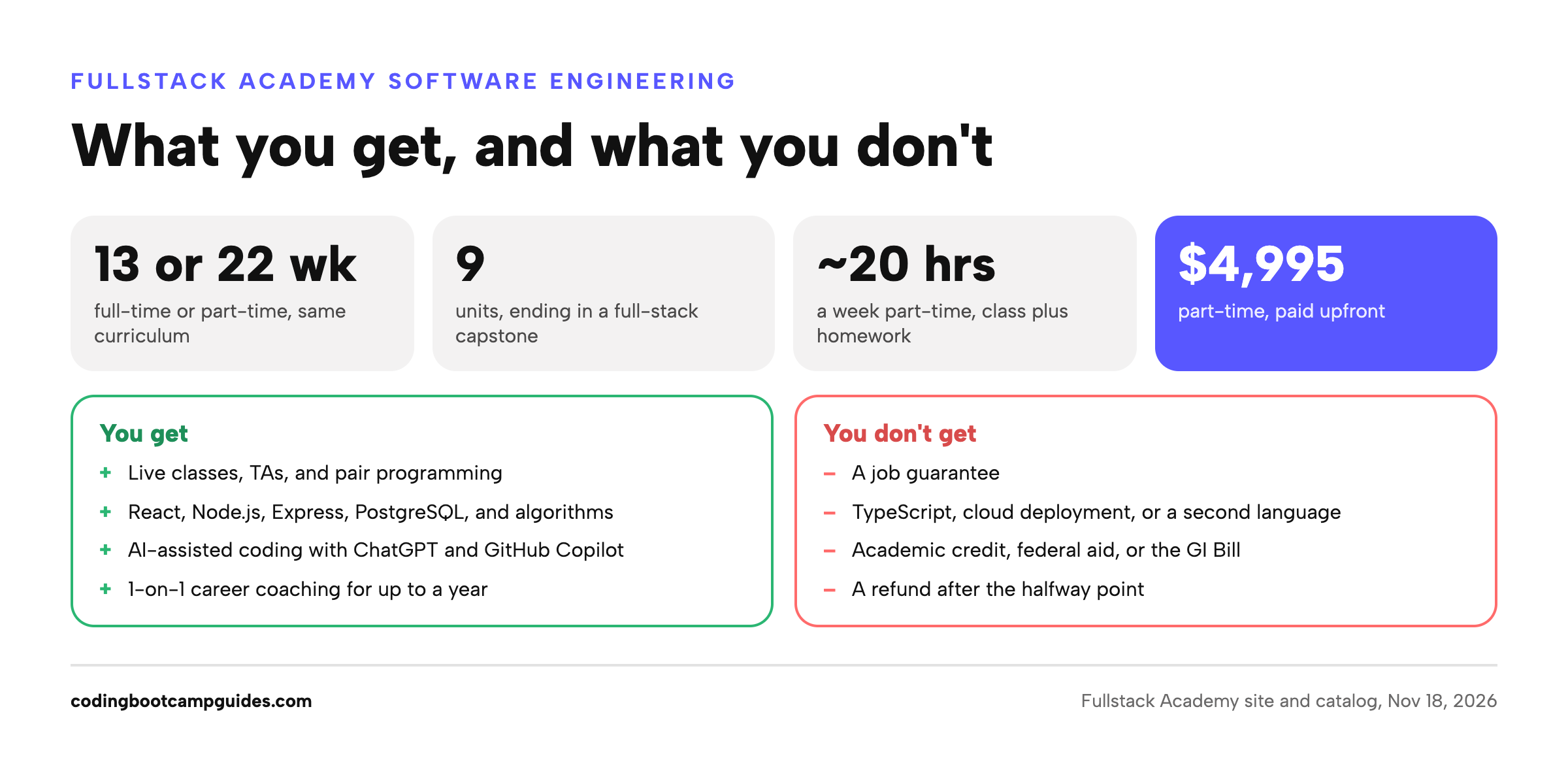
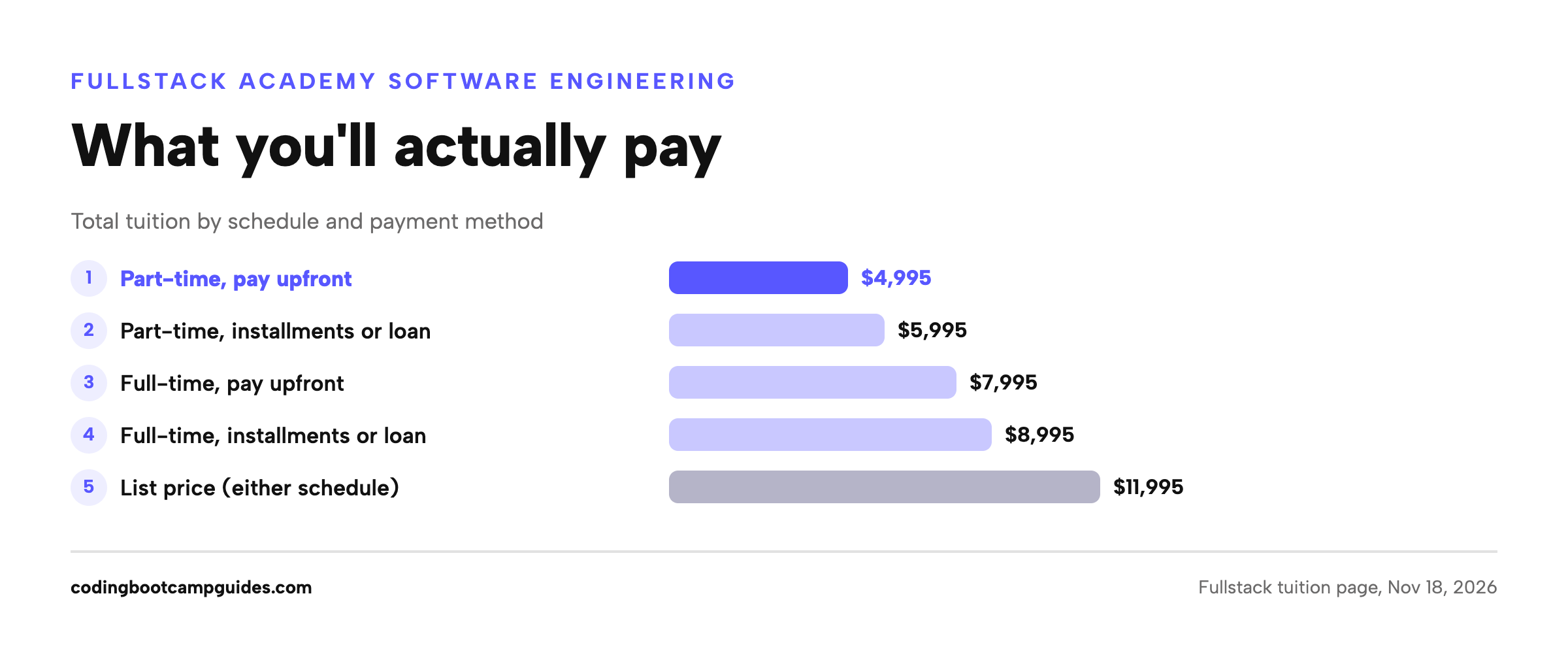
The short answer: it’s one of the better-value live coding bootcamps right now: $4,995 part-time or $7,995 full-time if you pay upfront, for live classes every session, pair programming, and a year of career coaching. The curriculum is a standard React, Node.js, and PostgreSQL stack with AI-assisted coding added. Go in clear-eyed about jobs: Fullstack’s outcomes report says coding graduates who found jobs averaged $79,118, and only 55% of those surveyed were hired within six months. Attendance rules are strict, and there’s no refund after the halfway point.
Fullstack Academy Software Engineering at a glance
| Software Engineering bootcamp | |
|---|---|
| What you learn | Full-stack JavaScript: HTML, CSS, React, Node.js, Express, PostgreSQL, algorithms, and AI coding tools |
| Format | Live online classes with an instructor, teaching assistants, and pair programming |
| Full-time | 13 weeks, Monday–Friday, 10am–2pm ET (260 class hours) |
| Part-time | 22 weeks, Monday, Wednesday, and Thursday, 7:30–10:30pm ET (198 class hours), plus 10–12 hours of homework a week |
| Price | $4,995 part-time or $7,995 full-time if you pay upfront; $1,000 more in installments or with a loan; $11,995 list |
| Next starts | Part-time December 14, 2026; full-time January 25, 2027 |
| Prior experience | None required |
| Career support | 1-on-1 career coaching for up to a year after graduation |
| Job guarantee | None |
| Credential | Certificate of completion (not academic credit) |
Schedules and prices
| Schedule | Dates | Pay upfront | Installments or loan | List price |
|---|---|---|---|---|
| Part-time: Mon, Wed, Thu, 7:30–10:30pm ET | Dec 14, 2026 – May 27, 2027 (apply by Nov 20) | $4,995 (“limited time offer”) | $5,995 | $11,995 |
| Full-time: Mon–Fri, 10am–2pm ET | Jan 25 – Apr 16, 2027 (apply by Dec 18) | $7,995 | $8,995 | $11,995 |
Prices and dates are from Fullstack’s tuition page on November 18, 2026. Fullstack says the part-time and full-time programs share the same curriculum, projects, and career support, so the part-time option is the better deal if you can stretch it over five months.
A few things to know about paying:
- The discounts move. The list price is $11,995, but almost nobody pays it. The part-time price is marked “limited time offer,” and Fullstack’s payment page says upfront payment saves “up to $3,000,” while the tuition page shows $7,000 off part-time. Get your price in writing in the enrollment agreement.
- Installments are interest-free, with no credit check, and cost $1,000 more than paying upfront.
- Loans go through outside lenders. The only one Fullstack names is Climb. A loan costs the same as installments, plus interest.
- A $500 deposit holds your seat, refundable until the end of the first week of classes.
- Scholarships are small: $1,000 for active-duty military and veterans or for Georgia residents, one per student.
- No GI Bill. Fullstack says it can’t accept it because the program is online.
- Switching cohorts costs $1,000, and once you transfer, you can no longer get a refund.
For other ways to fund a bootcamp, see our guide to paying for a coding bootcamp, and run your numbers through the bootcamp break-even calculator.
Who runs it
Fullstack Academy opened in New York in 2012 as an in-person JavaScript bootcamp and now teaches only online, from headquarters in Atlanta. Zovio sold it to Simplilearn in an all-cash deal announced in November 2022, and Fullstack now calls itself “a Simplilearn company.” Its catalog says it’s authorized to operate by Georgia’s Nonpublic Postsecondary Education Commission, and its website footer says it’s licensed by the New York State Education Department. It isn’t accredited and doesn’t take federal financial aid.
Admissions
There’s no coding test and no experience requirement. You need to be 18 or older with a high school diploma or equivalent. You apply online and talk with a student advisor, and accepted students must register at least seven days before their cohort starts.
You’ll need your own laptop or desktop with a webcam and microphone; Chromebooks, iPads, and tablets aren’t allowed. Fullstack strongly recommends a Mac for this program: its catalog says Windows is supported but takes “more complex machine setup.”
Because admissions is open, it’s on you to check you’re ready. If you’ve never written code, spend a few weeks on free basics such as freeCodeCamp’s JavaScript lessons or The Odin Project before day one. Thirteen weeks is fast.
What you’ll learn
The curriculum has nine units:
- Front-End Foundations: HTML, CSS, the command line, Git, and GitHub.
- Essentials of Generative AI: how large language models work and prompt engineering.
- Front-End Development and Front-End Libraries: JavaScript, APIs, and React.
- Designing Applications With Generative AI: AI tools for UI design and code generation.
- Back-End Development: Node.js, Express, PostgreSQL, and authentication with JSON Web Tokens and bcrypt.
- Smart Coding and Testing With Generative AI: AI-assisted code generation, refactoring, and test automation with tools like ChatGPT and GitHub Copilot.
- Algorithms and Data Structures.
- Full-Stack Development Capstone Project.
Fullstack says graduates are prepared for entry-level roles such as junior software engineer and front-end developer. That’s a standard, sensible first stack, and the algorithms unit helps with technical interviews. Three of the nine units are about generative AI, which is useful, but it’s time not spent on core engineering. What’s missing from the published list: TypeScript, cloud deployment, and anything beyond JavaScript. Ask for the full syllabus if those matter to you.
What a week looks like
Every class is live. A full-time day runs four hours, 10am–2pm ET: a review, live instruction, guided practice, a one-hour break, and open help time, with much of the work done in pairs. The catalog doesn’t say how much homework full-time students should expect, so ask. Part-time students get 9 hours of class a week plus 10–12 hours of homework, by the catalog’s count, so plan on about 20 hours a week for five months.
Attendance is strict, and the catalog spells it out:
- Your camera must be on to count as present.
- Miss the first week and you’re withdrawn.
- No more than 4 absences full-time, or 8 part-time. Four late arrivals or early exits of more than 15 minutes count as one absence.
- Missed assessments or project deadlines without approval in advance risk a failing grade or dismissal. You need a cumulative 70% to pass.
- Leaves of absence are “not generally granted”; extended absences usually mean moving to a later cohort for the $1,000 transfer fee.
That structure keeps people moving, which is the point of a live bootcamp. If your job or family schedule is unpredictable, a self-paced program such as Springboard may be safer.
Outcomes for software engineering graduates
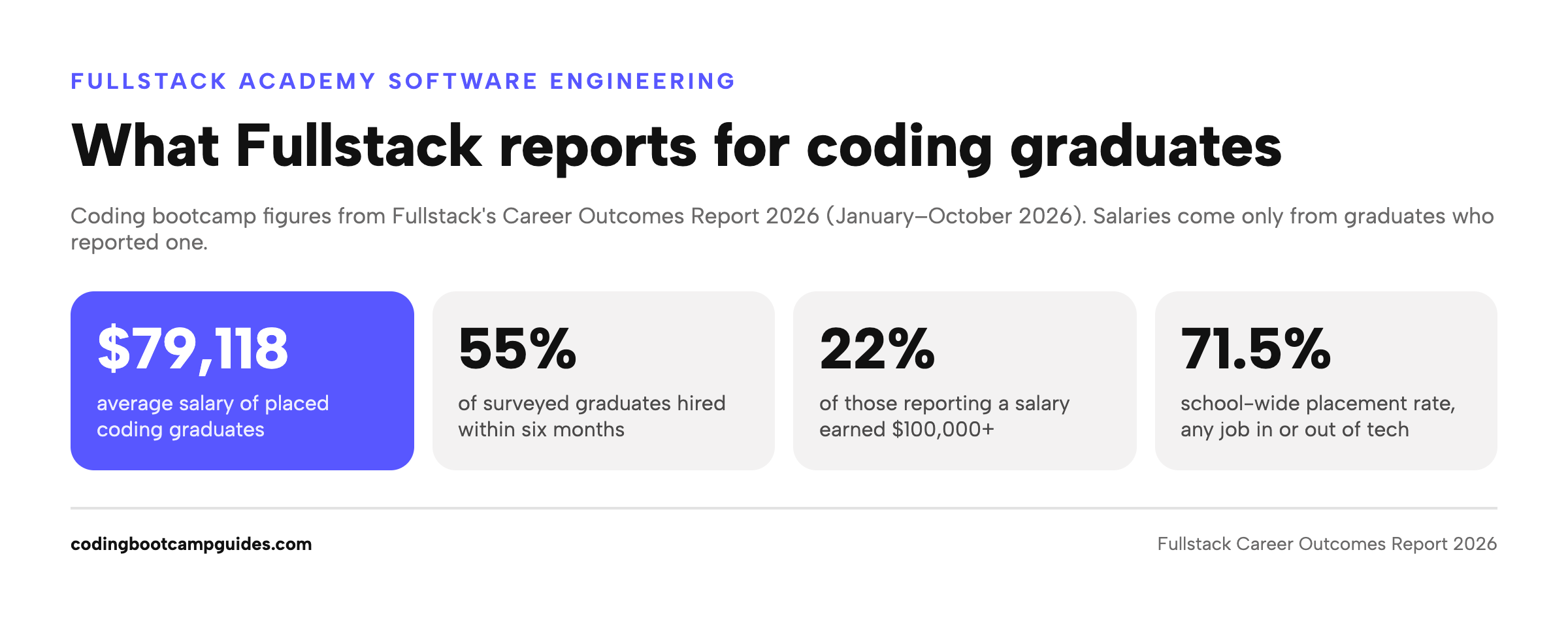
Fullstack’s Career Outcomes Report 2026 (January to October 2026) gives these figures for its coding bootcamp:
| Figure | Coding bootcamp |
|---|---|
| Average salary of placed graduates | $79,118 |
| Graduates reporting a salary of $100,000 or more | 22% |
| Highest reported salary | $190,000 |
| Surveyed graduates hired within six months | 55% |
| Roles graduates landed | Software engineer, full-stack developer, front-end developer, Appian developer, QA analyst |
Those numbers come only from graduates who reported a salary or answered a survey. The report doesn’t give a placement rate for the coding bootcamp alone. Its school-wide 71.5% placement rate counts full-time, part-time, or contract jobs “inside or outside tech,” and three in four of those placements were in tech or tech-adjacent roles.
The only program-level enrollment and placement data Fullstack publishes is in its academic catalog, and it covers a single university partner: of 23 graduates of the Emory software engineering bootcamp Fullstack runs, 1 was reported placed in the field between March 2025 and February 2026. The catalog Fullstack shares with its other university partners has no outcomes data. Ask admissions for completion and placement figures for your schedule before you pay.
Refunds and withdrawals
- Full refund if you cancel within 7 days of signing the enrollment agreement.
- Before 50% of the program, tuition is refunded “at a prorated amount, based on the percentage of paid segment completed.”
- After 50%, no refund. That’s roughly week 7 full-time or week 11 part-time.
- Withdraw in writing (by email to withdraw@fullstackacademy.com) within a week of your last day, or the catalog warns of “additional financial obligations.”
- Disputes go to arbitration, with a class-action and jury waiver.
These terms are from Fullstack’s catalog; your enrollment agreement is the final word. There’s no job guarantee: the catalog says “the school cannot guarantee a job to any student or graduate.”
Career support
You get a career coach during the bootcamp for résumés, LinkedIn and GitHub profiles, mock interviews, job-search strategy, and salary negotiation, plus workshops and a job board. After graduation, you can opt in to job-search support for up to a year. Fullstack can remove you from it if you stop communicating with your coach, stop actively searching, or start working 12 or more hours a week outside the field.
The same bootcamp under a university name
Fullstack runs this bootcamp for a dozen universities. It’s sold on the university’s website under the university’s name; Emory’s page, for example, says its coding bootcamp is “facilitated by Fullstack Academy instructors and staff.” The schedule and curriculum match Fullstack’s own. Prices checked on each university’s bootcamp site on November 18, 2026:
| University | Upfront price | List price |
|---|---|---|
| Cal Poly (Extended Education) | $4,995 part-time / $7,995 full-time | $11,995 |
| Cal State East Bay | $4,995 / $7,995 | $11,995 |
| Cleveland State University | $4,995 / $7,995 | $11,995 |
| Colorado State University | $4,995 / $7,995 | $11,995 |
| Emory University | $4,995 / $7,995 | $11,995 |
| Michigan Engineering | $4,995 / $7,995 | $11,995 |
| University of North Florida | $4,995 / $7,995 | $11,995 |
| University of Oklahoma | $4,995 / $7,995 | $11,995 |
| University of San Diego | $4,995 / $7,995 | $11,995 |
| Virginia Tech | $4,995 / $7,995 | $11,995 |
| LSU Online | $8,995, either schedule | $11,995 |
| UT Dallas | $8,995, either schedule | $11,995 |
Most charge exactly what Fullstack does. LSU Online and UT Dallas sell through Simplilearn’s platform at a single $8,995 price, which is $4,000 more than Fullstack’s own part-time option. Former partners have dropped off: the University of Illinois Chicago’s bootcamp site now redirects to uic.edu, San José State’s is offline, and Wake Forest’s redirects to its professional studies school.
The university version gets you a certificate with the university’s name on it (LSU’s and UT Dallas’s are joint certificates with Fullstack). It doesn’t get you academic credit, university faculty, or federal aid. If the name helps you, take it at the same price; don’t pay extra for it.
What students say
Review sites mostly rate Fullstack as a whole, not this program alone. Course Report shows 4.79 out of 5 from 440 reviews across all Fullstack programs. Trustpilot shows 3.9 out of 5 from only 16 reviews, split between five stars (50%) and one star (44%). In recent software engineering reviews, students praise knowledgeable, supportive instructors and a well-structured curriculum; the recurring complaints across programs are large cohorts with little one-on-one time and how much work happens outside class. Treat review sites as signals, not proof.
Pros and cons
Pros
- Live teaching every session, with TAs and pair programming.
- Good value: $4,995 part-time or $7,995 full-time upfront, versus $16,980 or more for Hack Reactor.
- Part-time and full-time share the same curriculum and support.
- No coding experience required.
- A standard, job-relevant stack (React, Node.js, PostgreSQL), plus algorithms and AI-assisted coding.
- A year of career coaching after graduation.
Cons
- Modest outcomes: coding graduates who found jobs averaged $79,118, and 55% of those surveyed were hired within six months.
- A fast pace for true beginners: 13 weeks full-time with open admissions.
- Strict attendance and few options if life gets in the way.
- No refund after the halfway point, and mandatory arbitration.
- Moving discounts off an inflated list price.
- No TypeScript, cloud, or second language on the published syllabus.
- No GI Bill, federal aid, or academic credit.
From Michael, Hack Reactor ’16: This is very close to the bootcamp I attended: live JavaScript, React and Node, a cohort, and a fixed schedule. That structure is what got me through Hack Reactor, and at $4,995 part-time Fullstack sells it for less than a third of Hack Reactor’s price. What I’d think hard about is the job market, not the teaching. Junior developer jobs are competitive, and Fullstack’s own report shows it: only about half of surveyed coding graduates were hired within six months. If you go, start the job search on day one, build something beyond the capstone, and treat the certificate as the least important thing you leave with.
Who should choose it?
- Good fit: you want live classes and a fixed schedule, can give about 20 hours a week for five months (or full days for three), can pay upfront, and are ready to run a serious job search alongside the course.
- Look elsewhere: your schedule is unpredictable, you need the GI Bill or federal aid, you want a job guarantee, or you’ve never coded and don’t want to prepare first.
- Not sure yet? Do a month of The Odin Project or freeCodeCamp first. If you enjoy it and keep going, you’ll get far more from the bootcamp.
Alternatives
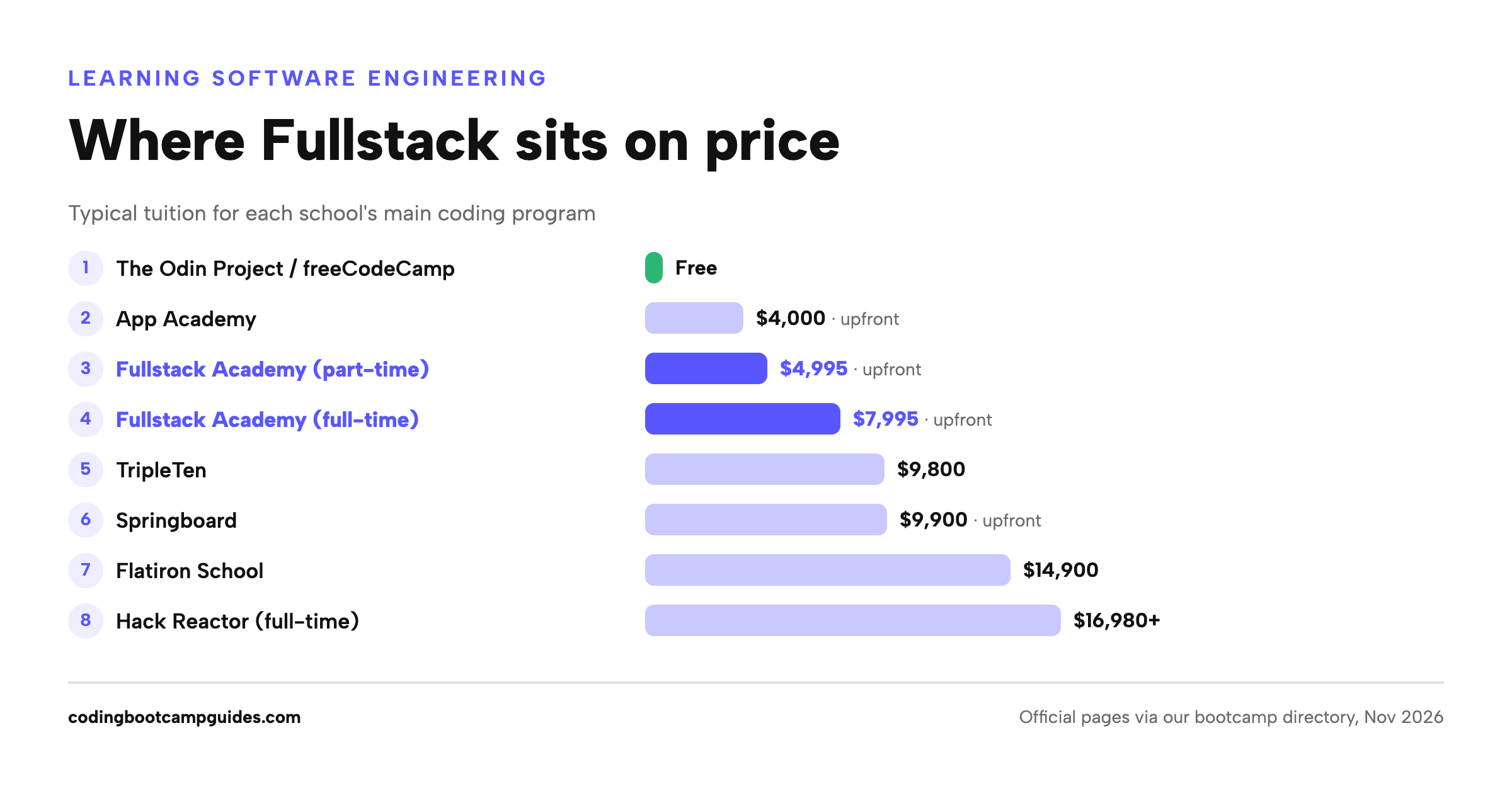
Prices are from our bootcamp directory, checked in November 2026.
| Program | Price | Format | Best for |
|---|---|---|---|
| Fullstack Academy Software Engineering | $4,995 part-time / $7,995 full-time upfront | Live online; 22 or 13 weeks | Live classes at a mid-range price |
| App Academy AI Software Engineering | $4,000 upfront ($10,000 list) | Live online, part-time; 4–6 months | The lowest-cost live option |
| TripleTen Software Engineering | $9,800 | Part-time online; about 7 months | A set cohort at a similar price |
| Springboard Software Engineering | $9,900 upfront | Self-paced with a mentor; 9 months | Unpredictable schedules; money-back guarantee |
| Flatiron School Software Engineering | $14,900 | Online, full- or part-time | A longer-established brand |
| Hack Reactor | $16,980–$19,480 full-time | Live online; 16 weeks full-time or 30 part-time | A more intense full-time immersive |
| The Odin Project, freeCodeCamp | Free | Self-paced, no instructor | Testing your interest first |
Fullstack’s other bootcamps
Fullstack also runs a Cybersecurity bootcamp ($8,995 upfront), a Data Analytics bootcamp ($4,995), and an AI & Machine Learning bootcamp ($4,995). They have different curricula, schedules, prerequisites, and outcomes, so we review each one separately.
Questions to ask before you pay
- What is my total price for this schedule, and is it written into my enrollment agreement?
- How many students are in a cohort, and how many instructors and TAs?
- Can you send enrollment, graduation, and in-field placement figures for the software engineering bootcamp?
- What should I learn before day one if I’ve never coded?
- If I fall behind or have an emergency, what are my options and what do they cost?
- If I’m looking at a university version: is anything different from Fullstack’s own program, and why is the price different?
The verdict
Fullstack Academy’s Software Engineering bootcamp is a well-built live program at a fair price, especially part-time at $4,995 upfront. You get real teaching, a standard full-stack curriculum, and a year of coaching. What you don’t get is any assurance about jobs: only 55% of surveyed coding graduates were hired within six months, and junior developer roles are scarce. Choose it for the structure and teaching, budget time for a long job search, and skip the university versions that charge more for the same course.
Still comparing? Browse every option in our bootcamp directory, or read our Hack Reactor, App Academy, and Springboard reviews.
Fullstack Academy Software Engineering FAQ
Is Fullstack Academy worth it?
For its Software Engineering bootcamp, it can be if you want live classes and can pay upfront: $4,995 part-time or $7,995 full-time buys 13–22 weeks of live instruction and a year of career coaching. Job outcomes are the weak point, so plan for a long search.
How much does the Fullstack Academy coding bootcamp cost?
As of November 18, 2026: $4,995 part-time or $7,995 full-time if you pay upfront, $5,995 or $8,995 in installments or with a loan, and $11,995 list.
How long is the Fullstack Academy coding bootcamp?
13 weeks full-time (Monday–Friday, 10am–2pm ET) or 22 weeks part-time (three evenings a week), plus homework. The curriculum is the same on both schedules.
Do I need coding experience for Fullstack Academy?
No. Admission requires a high school diploma and being 18 or older, with no coding test. Because the pace is fast, learning some JavaScript basics first is a good idea.
Is Fullstack Academy the same as university coding bootcamps?
Many university coding bootcamps, including Emory, Virginia Tech, Cal Poly, Colorado State, Oklahoma, San Diego, UT Dallas, and LSU Online, are Fullstack’s program sold under the university’s name. Most cost the same; LSU Online and UT Dallas charge $8,995.
Does Fullstack Academy have a job guarantee?
No. Its catalog says it cannot guarantee a job. It offers career coaching for up to a year after graduation.

Michael has a diverse background in software engineering, mechanical engineering, economics, and management. After a successful career in mechanical engineering, Michael decided to become a software engineer and attended the Hack Reactor coding bootcamp. Michael enjoys writing about his experiences and helping others start their journeys in software development.