By Michael Stromberg, Hack Reactor graduate (2016) · Last verified November 8, 2026
Coding bootcamps cost anywhere from about $4,000 to more than $20,000, and very few students pay that sticker price out of pocket. The way you pay matters almost as much as the school you choose: the same $15,000 program can cost you $15,000 or more than $25,000 depending on how you finance it. This guide covers every way to pay for a bootcamp, ordered from the cheapest money to the most expensive.
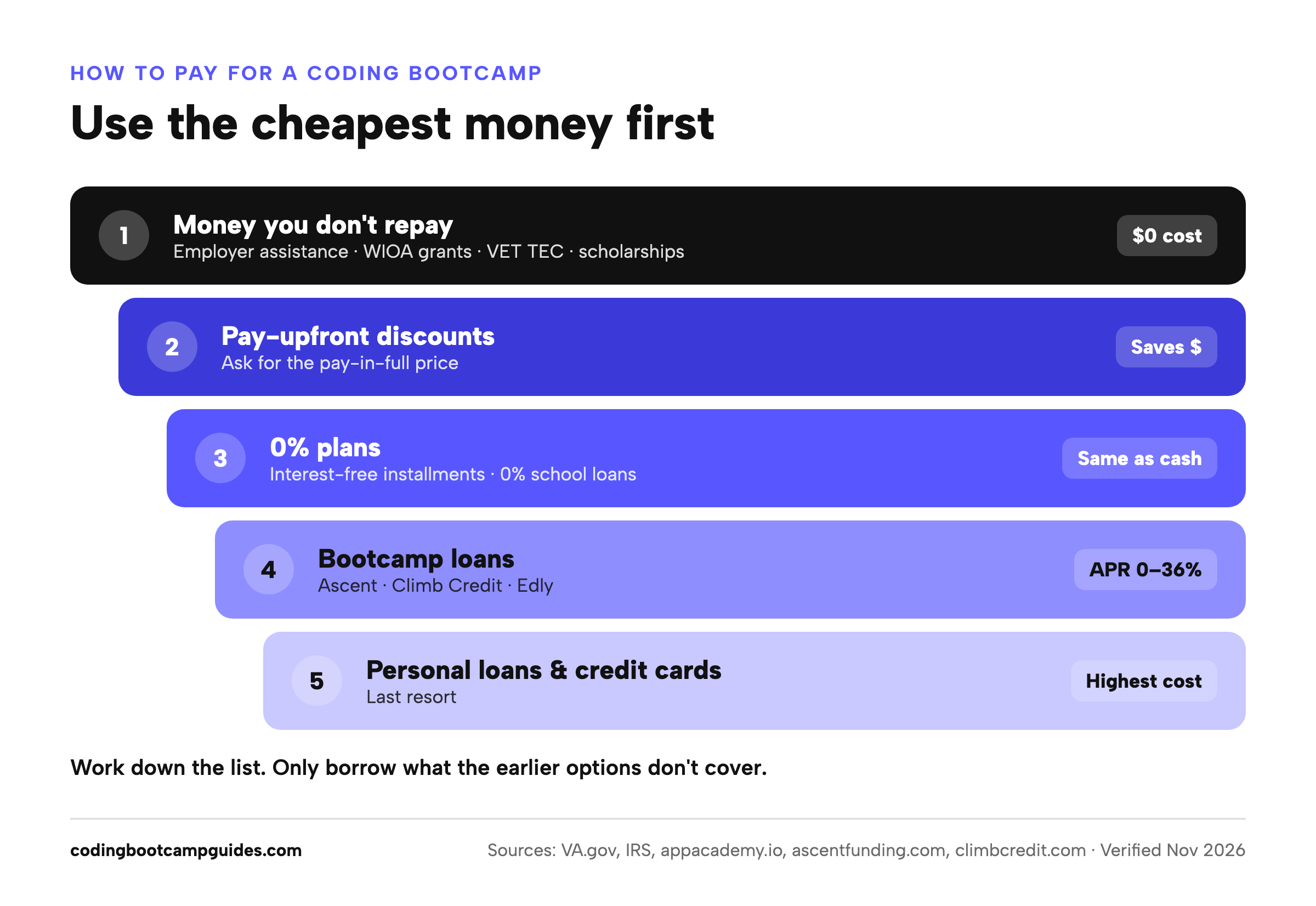
The short answer: use the cheapest money first
- Money you don’t repay: employer tuition assistance, workforce grants (WIOA), VET TEC for veterans, and scholarships.
- Discounts for paying upfront: some schools cut tuition by thousands if you pay in full.
- 0% plans: interest-free installment plans and 0% loans offered through some schools.
- Bootcamp loans: lenders such as Ascent and Climb Credit that partner with schools.
- Last resort: personal loans and credit cards.
Work down the list. Only borrow for what the earlier options don’t cover.
1. Employer tuition assistance
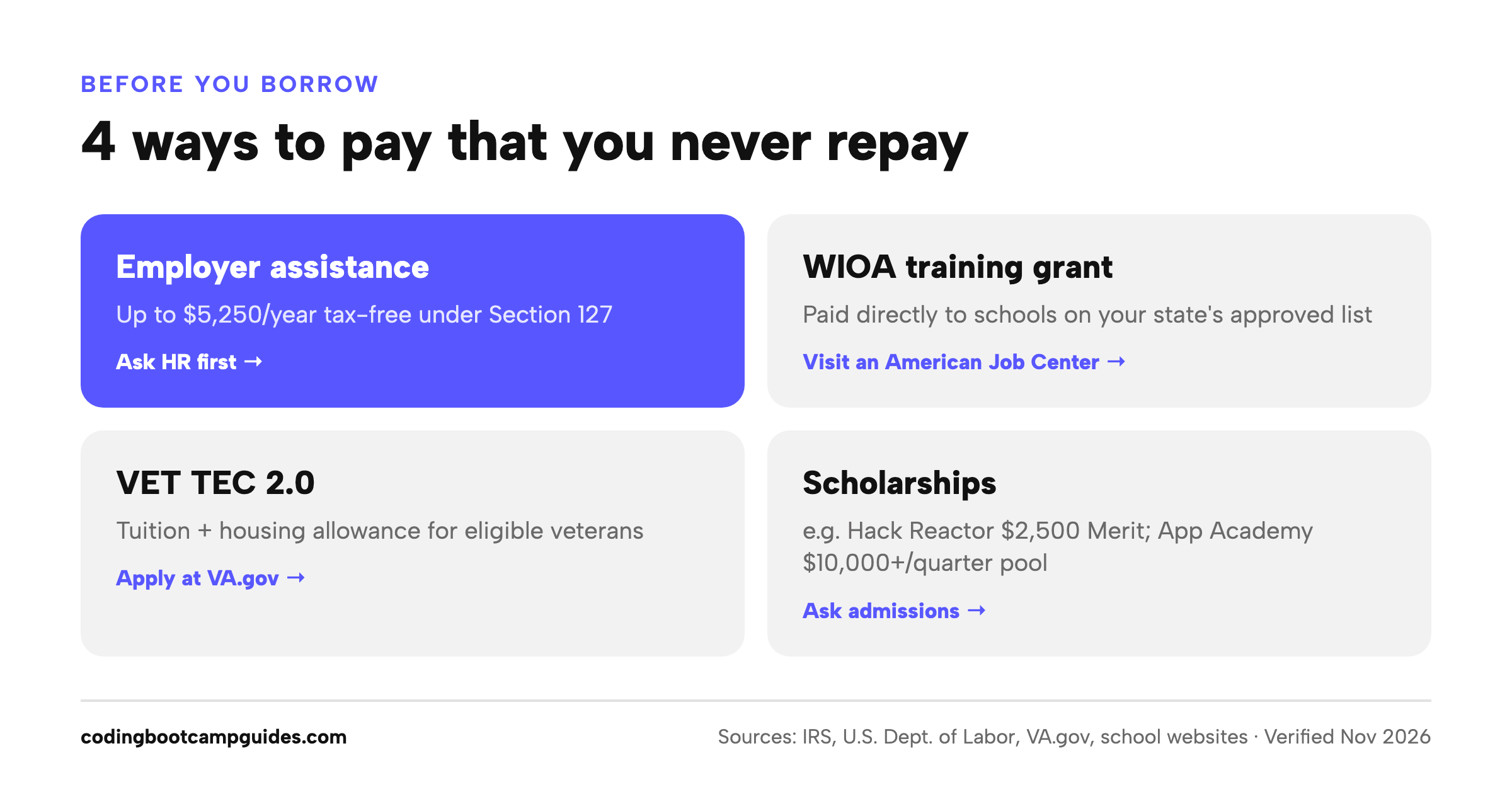
If you have a job, ask HR before you do anything else. Under Section 127 of the tax code, an employer can pay up to $5,250 a year of your education costs tax-free, and since 2025 that benefit can also go toward paying down student loans. Many companies will also fund training that’s relevant to your current role, especially if you’re moving into a technical position internally.
Some bootcamps accept employer payments directly. App Academy, for example, lets employers pay through its upfront or installment options.
2. Workforce grants (WIOA)
The federal Workforce Innovation and Opportunity Act funds job training for people who’ve been laid off and for lower-income adults. If you qualify, your local American Job Center can approve an Individual Training Account: a grant, not a loan, paid directly to the school.
The catch: the specific program must be on your state’s Eligible Training Provider List (ETPL), and you need approval before you enroll. To check:
- Find your nearest American Job Center on CareerOneStop.org.
- Ask for a WIOA eligibility screening and a meeting with a career advisor.
- Search your state’s ETPL for the bootcamp you want.
- Get written funding approval before you sign an enrollment agreement.
3. VET TEC 2.0 for veterans
The VA’s tech training program is back. VET TEC 2.0 pays tuition at approved training providers and includes a monthly housing allowance. To qualify, you need at least 36 months of active duty, a discharge other than dishonorable (or be within 180 days of separating), and be under 62. The program is capped at 4,000 paid participants a year; when we checked VA.gov, it listed 2,273 openings.
One important change from the original pilot: if you still have GI Bill entitlement, VET TEC 2.0 uses one month of it for every month of full-time training. Veterans with no entitlement left can still apply. Openings are first come, first served, so apply early.
4. Scholarships
Most bootcamps offer some scholarship money, usually as a tuition discount. Hack Reactor gives a $2,500 Merit Scholarship to applicants who pass its admissions test, and App Academy says it awards more than $10,000 in scholarships each quarter. Always ask admissions what’s available, especially scholarships for women, veterans, and people from underrepresented groups in tech.
What about FAFSA and federal student aid?
For most bootcamps, federal aid isn’t an option. Federal student loans and Pell Grants only go to programs at accredited, federally approved institutions, and most bootcamps aren’t one.
That’s starting to change at the edges. Since July 1, 2026, Workforce Pell Grants can cover short training programs of 8 to 15 weeks, but only at accredited colleges, only for state-approved programs tied to in-demand jobs, and only for programs that meet completion and job-placement requirements. In practice, that means some community college tech certificates, not most private bootcamps. If a community college near you runs a short software or IT program, ask whether it’s Workforce Pell eligible.
5. Pay upfront if you can
Schools want cash upfront and will often pay you for it. The most extreme example right now is App Academy: its list price is $10,000, but paying in full costs $4,000. That’s a $6,000 discount for the same program. Before you choose a financing plan, always ask: “What’s the price if I pay in full?”
6. Installment plans and 0% loans
Many schools let you split tuition into payments. Hack Reactor, for example, lets you split tuition into two equal payments. Some lenders also offer 0% APR loans at schools that choose to subsidize them: Ascent offers a Zero Percent Loan with no origination fee at certain schools, and Climb Credit offers 0% loans where the school opts in.
Read installment terms carefully. Check whether there’s interest, whether a credit check is required, and what the total adds up to. App Academy, for example, advertises installments “from $155/month for 48 months,” which works out to $7,440, not its $10,000 list price or its $4,000 upfront price.
7. Bootcamp loans
Bootcamp loans come from private lenders that partner with schools. They’re consumer loans, not federal student loans: no income-driven repayment, no federal forgiveness, and the interest isn’t tax-deductible.
| Lender | How it works | Watch for |
|---|---|---|
| Ascent | Covers up to 100% of tuition at partner schools. Choose interest-only payments during the program, minimum payments, or full payments right away. 1% APR discount with autopay. No prepayment penalty. | 5% origination fee added to your balance (except on 0% loans) |
| Climb Credit | School-partnered loans, with deferred and interest-only options depending on the school. Rates are fixed. | APRs range from 0% to 36%, including an origination fee of up to 5%. Climb says most of its loans are under 19%. |
| Edly | Income-based repayment after you graduate (used by App Academy). Payments are recalculated yearly, and you can pause if you earn below a threshold. | Interest keeps accruing while payments are paused |
| School-specific loans | Some schools use other partners, such as Clasp for Hack Reactor’s Payment Protection Loan, which defers payments if you can’t find a job. | Deferral isn’t forgiveness; read what happens to interest |
You may also see income share agreements (ISAs), where you pay a percentage of your salary after you’re hired. They were popular a few years ago, but most schools have replaced them with conventional loans, and regulators treat them as loans. Compare an ISA’s maximum total payment to a loan’s total cost before signing one.
8. Personal loans and credit cards: last resort
A personal loan from a bank or credit union can sometimes beat a bootcamp loan’s rate if you have strong credit, so it’s worth comparing. Credit cards almost never make sense: the interest rates are high, and some schools charge an extra fee to pay by card (Hack Reactor charges 2.8%).
What financing actually costs: a $15,000 example
| How you pay | Monthly payment | Total you pay |
|---|---|---|
| Upfront or 0% installment plan | n/a | $15,000 |
| Loan at 12% interest + 5% fee, 3 years | $523 | $18,833 |
| Loan at 20% interest + 5% fee, 5 years | $417 | $25,037 |
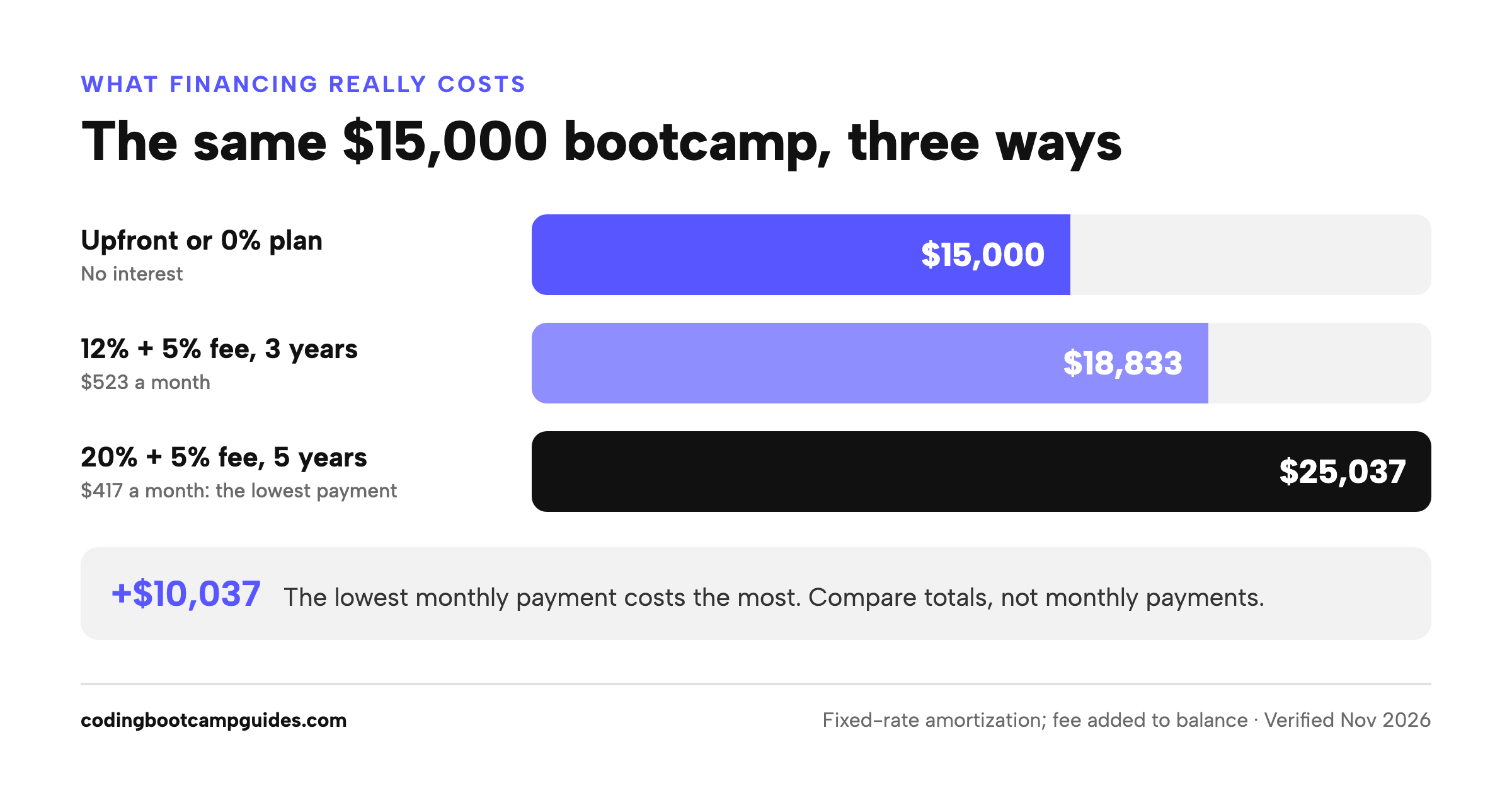
The longer, higher-rate loan has the lowest monthly payment and costs $10,000 more. Interest-only payments during the program add more on top. Lenders lead with the monthly number; you should look at the total. Then run that total through our bootcamp break-even calculator to see how long it would take a new salary to pay it back.
Before you sign: a checklist
- The total cost, not the monthly payment: principal, interest, and fees combined.
- The APR, which includes fees, not just the interest rate.
- When payments start: during the program, or after you graduate?
- What happens if you withdraw: the school’s refund policy and whether the loan is reduced.
- What happens if you don’t get a job: any deferral, and whether interest keeps growing.
- Prepayment penalties: you want none.
- Whether you need a cosigner, and what it means for them if you can’t pay.
From Michael, Hack Reactor ’16: A bootcamp is a bet on yourself, and debt raises the stakes. The job search after graduation took my classmates anywhere from a few weeks to many months, and the people under the most pressure were the ones whose loan payments started before their first paycheck. If you have to borrow, borrow the least you can, choose a plan that doesn’t require full payments until a few months after you finish, and keep enough savings to cover at least three to six months of living expenses after graduation. The cheapest bootcamp is the one you can finish without panicking about money.
How to pay for a coding bootcamp: FAQ
Can I use FAFSA for a coding bootcamp?
Usually not. Federal aid only covers programs at accredited, federally approved institutions, and most bootcamps don’t qualify. Since July 2026, Workforce Pell Grants cover some short programs at accredited colleges, and some university-run bootcamps that award academic credit may qualify. Ask the school directly.
Can I use the GI Bill for a coding bootcamp?
Some bootcamps are approved for GI Bill benefits, and VET TEC 2.0 pays for approved tech training programs, plus a housing allowance. VET TEC 2.0 uses one month of any remaining GI Bill entitlement per month of full-time training.
Can I get a coding bootcamp for free?
Possibly, through employer tuition assistance, a WIOA training grant, or VET TEC 2.0. Those are the routes that don’t require repayment. Free learning resources like freeCodeCamp and The Odin Project are another way to start before paying for anything.
Is bootcamp loan interest tax-deductible?
Generally no. Bootcamp loans are consumer loans, not qualified student loans; Ascent, for example, states that interest on its career training loans isn’t tax-deductible.
What credit score do I need for a bootcamp loan?
Lenders don’t publish a minimum, and approval and rate depend on your credit history. Checking your rate with lenders like Ascent doesn’t affect your credit score, and adding a cosigner with strong credit can lower your rate.